
2-3 Zone Defense
How a 2-3 zone is set up, where it is weak and the plays that attack it, drawn on a half court.
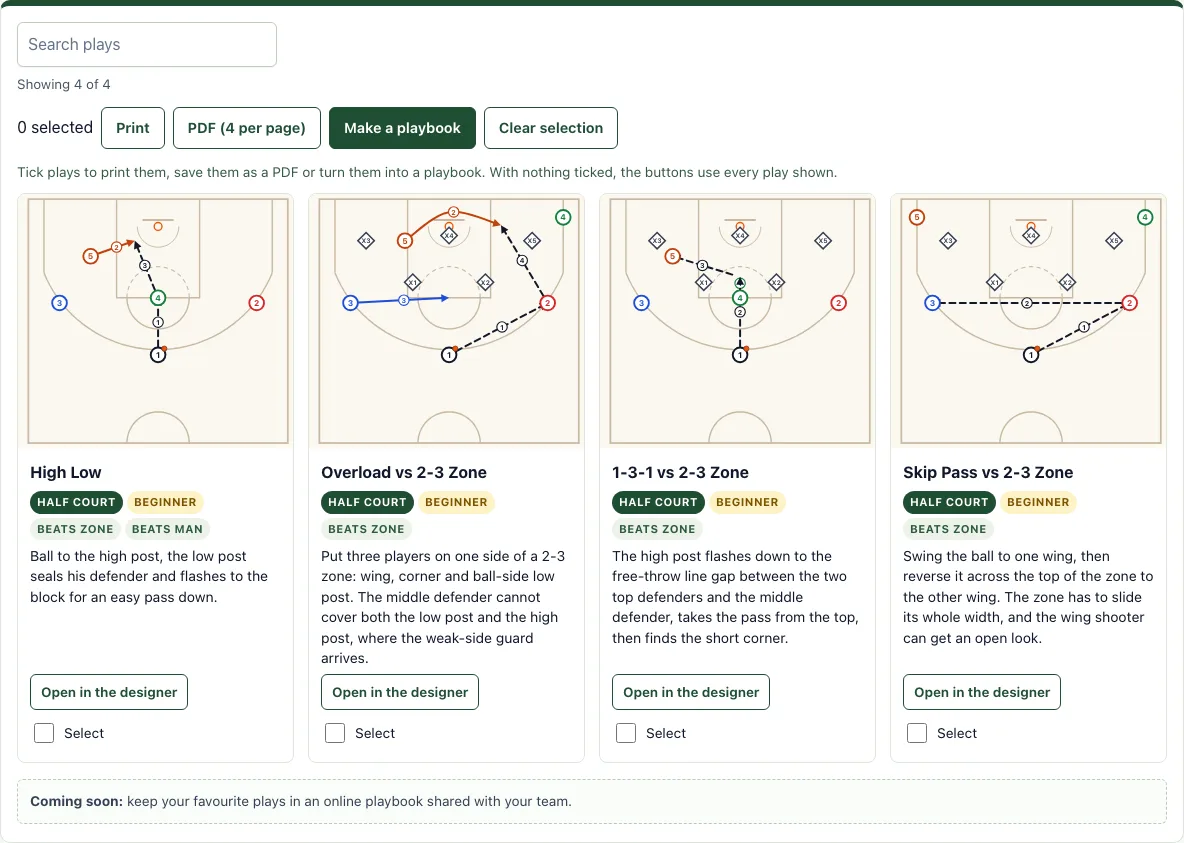
High Low
Ball to the high post, the low post seals his defender and flashes to the block for an easy pass down.
Overload vs 2-3 Zone
Put three players on one side of a 2-3 zone: wing, corner and ball-side low post. The middle defender cannot cover both the low post and the high post, where the weak-side guard arrives.
1-3-1 vs 2-3 Zone
The high post flashes down to the free-throw line gap between the two top defenders and the middle defender, takes the pass from the top, then finds the short corner.
Skip Pass vs 2-3 Zone
Swing the ball to one wing, then reverse it across the top of the zone to the other wing. The zone has to slide its whole width, and the wing shooter can get an open look.
Free · runs in your browser · nothing is uploaded
Recent
Your last 10 settings, saved only in this browser. Nothing is uploaded.
How to use the 2-3 zone defense plays
- Look at the cards. Each is a half court with your five players, the defenders where the card shows them, and numbered actions.
- Follow the numbers: passes, cuts and screens happen in the order shown.
- Read the coaching note under the diagram to see what the play is trying to exploit, such as the high post or the short corner.
- Tick the Select box on the plays you want. Your choice stays in this browser.
- Press Print or PDF. If nothing is ticked, every play shown is used, so you get all of them on a sheet for the bench.
- Press Open in the designer to change a play, or Make a playbook to send the ticked plays to the basketball playbook.
In practice, run a play against five teammates standing in the 2-3 shape, then change the starting spots in the designer to match your own players. Run each play several times from both sides of the court, because a zone that is easy to beat on one side may leave a different gap on the other. Print the sheet and keep it on the bench so substitutes can see which play is next.
What is a 2-3 zone defense?
A 2-3 zone is a defense where five players cover areas rather than people. Two guards stand near the free-throw line extended, and three players line up across the lower part of the lane: a defender at each side of the lane and one near the basket in the middle. The shape gives its name: two defenders up top, three below.
What are the strengths and weaknesses of a 2-3 zone?
The 2-3 zone protects the basket. Three players stay close to the rim, which makes drives hard. Rebounding is mixed: they are near the basket, but nobody has a fixed player to box out, so teach them to find a man and call it out. It also means less chasing than man-to-man.
Its weak spots are the gaps between the defenders. The free-throw line area, the high post, sits between the two top defenders and the lower three. The short corner, the baseline area between the corner and the lane, is also hard to cover. Teams that shoot well from outside, or that pass the ball quickly from side to side, make the zone stretch and open those gaps.
Who guards what in a 2-3 zone?
In a 2-3 zone, the two top defenders guard the ball on the perimeter, the wings and the area around the free-throw line. The three bottom defenders cover the paint, the short corners and the baseline. Defenders guard areas rather than individual players, so responsibilities shift as the ball moves.
| Defender group | Number | Areas covered |
|---|---|---|
| Top (often the guards) | 2 | Perimeter, wings, area around the free-throw line |
| Bottom | 3 | Paint, short corners, baseline (two on the lane sides, one in the middle near the basket) |
When the ball swings to a corner, the nearest bottom defender steps out to guard it. The defenders beside him slide over to cover the gap he leaves, so the shape stays intact.
The bottom three also start close to the basket, but no one has a set player to box out, so coaches have to teach them to find an opponent after every shot.
How do you beat a 2-3 zone defense?
Pass the ball quickly side to side so the zone has to shift, and put a player in the high post to take a pass in the middle. Overload one side with three players, such as a wing, a corner and a low post, so one defender has to guard two people. The plays on this page use these ideas, and the notes tell you which gap each one targets.
How do you teach a 2-3 zone to young players?
Teach the 2-3 zone one piece at a time. Start with players walking the ball around the perimeter so they learn to shift, then add hands up, talking, and one pass at a time before live play. Check your league first, since some youth leagues require man-to-man defense.
- Check the league rules. Some youth leagues require man-to-man defense, so confirm the zone is allowed before you spend practice time on it.
- Walk the ball around the perimeter. Have players stand in the 2-3 shape and move the ball slowly around the outside so they feel when to shift.
- Teach hands up and talking. Every defender should know the area they guard and the next area they slide to.
- Add one pass at a time. Introduce a single pass, drill it until players react correctly, then add the next.
- Finish with a scrimmage. Let the offense only pass, so defenders practice shifting against real movement. Print the plays on this page and run them as the attacking offense.
Who should play a 2-3 zone?
It suits teams with a tall player near the basket and teams that cannot keep up with fast guards in man-to-man. It is a poor choice against a team that shoots well from three, so most coaches keep man-to-man as a second option.
Frequently asked questions
Is it free and do I need an account?
Yes. The tool is free, needs no sign-up and runs in your browser.
Can I print it or save it as a PDF?
Yes. Tick the plays, then press Print or PDF. If nothing is ticked, both use every play shown.
Does it work on a phone or tablet?
Yes. The cards stack in one column on a phone, and Open in the designer lets you change a play with your finger.
What is the difference between a 2-3 and a 3-2 zone?
A 2-3 has two defenders at the top and three below, and a 3-2 has three on top and two below. The 3-2 guards the perimeter better and leaves more space near the basket.
Is a 2-3 zone legal at every level?
Zone defense is allowed in the NBA and FIBA rules, but some youth leagues require man-to-man. Check your league’s rules. In the NBA, the defensive three-second rule also stops a defender from staying in the lane for more than 3 seconds without guarding an opponent, so the middle defender has to keep moving and a classic 2-3 is changed there.
Can I use what I make here commercially?
Yes. Sheets, cards, diagrams and PDFs you make with this tool are yours to print, hand out, sell or put in your own products, such as a coaching book on KDP or a printable on Etsy, with no credit needed. You may not copy the tool or the site itself; see the terms.
Related tools
- Basketball plays: The full set of plays, including man-to-man sets.
- Basketball playbook: Put the plays you pick into one printable book.
- Basketball play designer: Draw your own play against a zone.
- Basketball court diagram: Check the court lines and measurements.
- Basketball whiteboard: Sketch the zone on a board during practice.