
6v6 Flag Football Plays
8 plays for 6 on 6 flag football with diagrams and reads. Print them or open any play to edit.
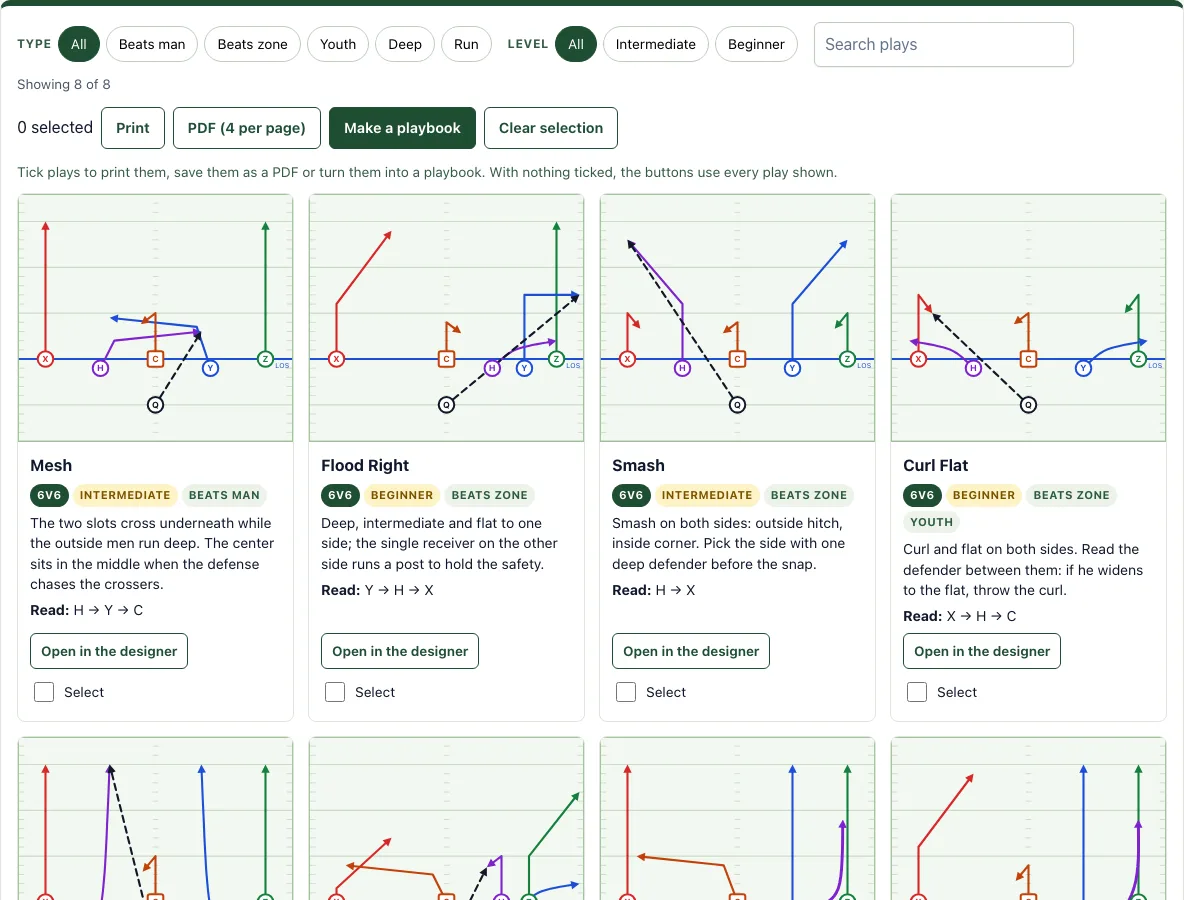
Mesh
The two slots cross underneath while the outside men run deep. The center sits in the middle when the defense chases the crossers.
Read: H → Y → C
Flood Right
Deep, intermediate and flat to one side; the single receiver on the other side runs a post to hold the safety.
Read: Y → H → X
Smash
Smash on both sides: outside hitch, inside corner. Pick the side with one deep defender before the snap.
Read: H → X
Curl Flat
Curl and flat on both sides. Read the defender between them: if he widens to the flat, throw the curl.
Read: X → H → C
Four Verticals
Four receivers stretch the field deep, the center checks down at 5 yards.
Read: H → Y → C
Bunch Snag
Corner, snag and flat from the bunch with a backside slant for a defense that rolls to the bunch.
Read: H → Z → Y
Jet Sweep
Flat motion from the left slot and a handoff on the move; the three receivers clear the right side deep.
Read: H
Pitch Sweep
Pitch to the back to the side of the two receivers, who run off their defenders.
Read: H
Recent
Your last 10 settings, saved only in this browser. Nothing is uploaded.
How to use the 6v6 flag football plays tool
- Use the filter buttons above the cards. Choose a type such as Beats man, Beats zone, Deep, Run or Youth, or a level: Beginner or Intermediate.
- Type a word into the search box to narrow the list. Check the count of plays shown to see how many are left.
- Read each card. It shows the diagram, the play name, the format, level and type tags, the coaching note, and the read order (for example, Z then X then C).
- Tick the Select box on each play you want to keep.
- Press Print or PDF (4 per page) to get a copy of your plays. If you haven’t selected any plays, these buttons use every play shown.
- To build a set of plays, select them and press Make a playbook. The playbook maker opens with your selected plays already in it.
- To change a play, press Open in the designer on its card.
The plays you tick stay ticked in this browser, so you can come back later and print the same set. Open in the designer loads the play at full size, where you can drag players, redraw a route, use Flip to run it to the other side and press Save in this browser; saved plays then appear in the playbook maker and the wristband template.
What are good 6v6 flag football plays?
Good 6v6 flag football plays give the quarterback a clear first read and a simple backup, and they put receivers in spots where defenders have to choose. Plays with short, quick throws keep the offense moving and reduce the chance of a sack, while deeper routes stretch the defense. A mix of pass and run concepts makes the offense harder to read.
The 6v6 offense in our diagrams uses C, Q, X, H, Y, and Z, with two slots. The extra receiver lets you run the same concept on both sides of the formation at once. That is why this page includes Smash on both sides and both sweep plays. Mesh, Flood Right, Curl Flat, Four Verticals, and Bunch Snag each send receivers to different depths and spots, so a team can pick the one that fits the defense it sees.
Every play is our own drawing of a common concept. Each one passes a rule check built from the NFL FLAG 5v5 rules: one forward pass from behind the line, the quarterback never runs the ball across the line, handoffs and pitches happen only behind the line, no blocking or screening, the center is on the line, and only one player is in motion. Those rules also set a 7-second limit for the quarterback to throw and allow up to two rushers who start 7 yards from the line.
How is 6v6 different from 5v5?
The main difference is the number of players. A 6v6 offense has one more player than a 5v5 offense, which gives the quarterback one more target and gives you more ways to spread the defense. The diagrams on this page use a 30-yard-wide field as the default, but leagues set their own field size, so check your league’s rules before you plan a game.
The rule check on this page uses the NFL FLAG 5v5 rules, not a separate 6v6 rulebook. If your league plays 6v6 with different rules, such as different rush distances or a different number of players allowed on the line, follow your league’s rules instead. Use the plays as a starting point and adjust them for your league.
Frequently asked questions
Is it free and do I need an account?
Yes, the tool is free. You do not need to sign up or create an account. It runs in your browser, and nothing you do on the page is uploaded.
Can I print it or save it as a PDF?
Yes. Select the plays you want and press Print or PDF (4 per page). If you select nothing, the buttons use every play shown on the page.
Does it work on a phone or tablet?
Yes. The play cards stack in one column on a phone, and Open in the designer lets you change any play with your finger.
What do the symbols in the diagrams mean?
Circles are offensive players with their position letter, and diamonds are defenders. The blue line is the line of scrimmage. Solid arrows are routes, zigzag lines are motion before the snap, dashed arrows are passes or pitches, and thick lines are runs. A dashed orange line marks the 7-yard rush line when a rusher is shown.
Are these plays copied from a team or league playbook?
No. All of the plays are our own drawings of common concepts. They were not copied from any league or team playbook.
Related tools
- All flag football plays: Use this when you want to compare plays across every format, not just 6v6.
- 5v5 flag football plays: Use this if your league plays 5 on 5 and you want plays sized for that roster.
- 7v7 flag football plays: Use this if your league plays 7 on 7 and you need plays for a larger offense.
- Flag football defense: Use this to plan how your defense will line up against the plays you pick.
- Flag football playbook PDF: Use this when you want a printable playbook to hand out to your team.
- Football play designer: Use this to draw or change your own plays from scratch.