
Flag Football Drills
16 drills with diagrams, steps and coaching points. Filter by age and skill and print the ones you need.
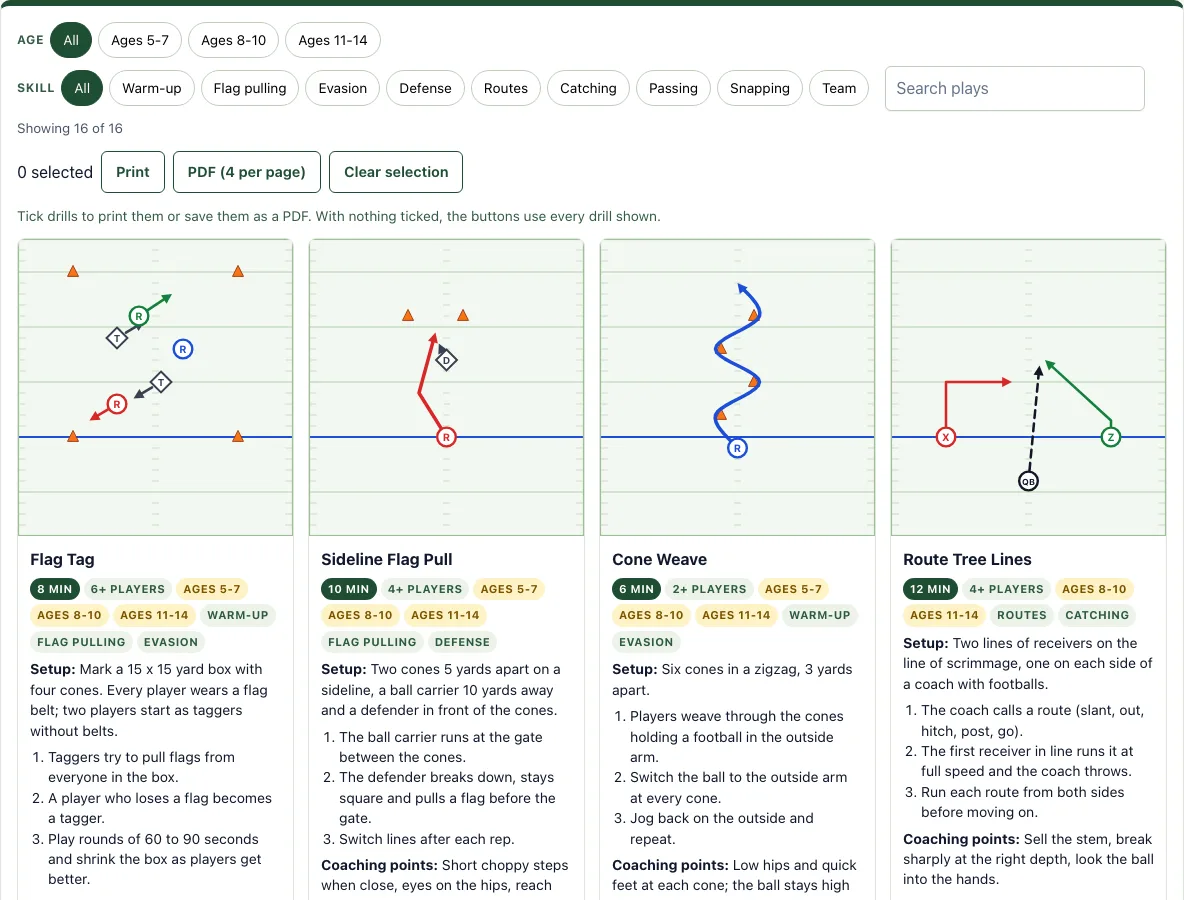
Flag Tag
Setup: Mark a 15 x 15 yard box with four cones. Every player wears a flag belt; two players start as taggers without belts.
- Taggers try to pull flags from everyone in the box.
- A player who loses a flag becomes a tagger.
- Play rounds of 60 to 90 seconds and shrink the box as players get better.
Coaching points: Pull with the hand, not a grab of the jersey; ball carriers keep their hands away from their flags (no flag guarding).
Sideline Flag Pull
Setup: Two cones 5 yards apart on a sideline, a ball carrier 10 yards away and a defender in front of the cones.
- The ball carrier runs at the gate between the cones.
- The defender breaks down, stays square and pulls a flag before the gate.
- Switch lines after each rep.
Coaching points: Short choppy steps when close, eyes on the hips, reach with both hands and keep the carrier on the sideline.
Cone Weave
Setup: Six cones in a zigzag, 3 yards apart.
- Players weave through the cones holding a football in the outside arm.
- Switch the ball to the outside arm at every cone.
- Jog back on the outside and repeat.
Coaching points: Low hips and quick feet at each cone; the ball stays high and tight.
Route Tree Lines
Setup: Two lines of receivers on the line of scrimmage, one on each side of a coach with footballs.
- The coach calls a route (slant, out, hitch, post, go).
- The first receiver in line runs it at full speed and the coach throws.
- Run each route from both sides before moving on.
Coaching points: Sell the stem, break sharply at the right depth, look the ball into the hands.
Target Passing
Setup: A quarterback and a partner 7 to 12 yards apart; two cones mark a 2-yard target window.
- The quarterback takes a short drop from a snap and throws to the partner standing in the window.
- Move the target left, right and deeper every five throws.
- Count completions out of ten.
Coaching points: Feet point at the target, elbow up, follow through; release within the 7-second pass clock.
Snap and Exchange
Setup: Centers and quarterbacks in pairs, quarterback in shotgun 4 to 5 yards back.
- The center snaps between the legs on the quarterback’s call.
- The quarterback catches it and sets his feet to throw.
- Ten snaps, then switch roles.
Coaching points: One rapid motion, the ball leaves the center’s hands completely; the quarterback calls the cadence.
1-on-1 Routes
Setup: A receiver against a defender in a 12-yard wide lane, a quarterback (or coach) throwing.
- The receiver picks a route without telling the defender.
- The defender plays man coverage and tries to break up the pass or pull the flag after the catch.
- Rotate receiver to defender to the back of the line.
Coaching points: Receivers: create space at the break. Defenders: stay in the receiver’s hip pocket and watch his eyes and hands.
Rush Line Drill
Setup: A rusher starts with a hand up at the 7-yard rush line; quarterback and center at the ball.
- On the snap the rusher goes straight at the quarterback.
- The quarterback must throw to a coach or receiver before the rusher pulls his flag.
- Count a coach’s 7-second clock out loud.
Coaching points: Rushers start behind the line, go immediately and do not jump to block the quarterback’s body; quarterbacks learn to throw quickly.
Zone Drops
Setup: Defenders in their zone alignment (for example 1-2-2) facing a coach with a ball.
- On the coach’s signal every defender drops to the middle of his zone.
- The coach turns and points the ball; all defenders break toward it.
- Repeat with throws to a receiver in a zone.
Coaching points: Eyes on the quarterback, sink into the zone, break on the throw together.
Tip Drill
Setup: Three players in a line 3 yards apart facing the coach.
- The coach throws to the first player, who tips it up to the next.
- The last player catches it and tucks it away.
- Rotate positions after each rep.
Coaching points: Soft hands, eyes on the ball until it is tucked.
Handoff Relay
Setup: Two teams in relay lines; a cone 10 yards away for each team.
- The first player runs around the cone and comes back.
- He hands the ball off (inside arm up, ball placed into the pocket) to the next player.
- First team to finish wins.
Coaching points: Handoffs are taught here: the receiver makes a pocket with the inside elbow up.
3-on-2 Keep Away
Setup: A 15 x 15 yard box. Three offensive players with a ball, two defenders.
- The offense passes the ball around; no running with the ball.
- Five completed passes score a point.
- An interception or drop swaps one defender in.
Coaching points: Move to open space, call for the ball, quick decisions.
Play Walk-Through
Setup: The offense lines up in the formation of the play you are installing; no defense.
- Walk the play at half speed while every player says his route out loud.
- Run it at full speed against air three times.
- Flip it to the other side.
Coaching points: Install two or three plays per practice at most; print the play card so players can see it.
Controlled Scrimmage
Setup: Full teams on a short field; the coach stands behind the offense and calls plays.
- Start each series from the 5-yard line of a short field.
- The coach stops play to correct one thing at a time.
- Rotate positions every series so everyone plays quarterback, center and defense.
Coaching points: Game rules apply: rush from 7 yards, 7-second pass clock, no blocking.
Quick Feet Ladder
Setup: An agility ladder or ten cones in a straight line one yard apart.
- Two feet in each square, then one foot, then lateral shuffles.
- Finish each pass with a 5-yard sprint.
- Two passes of each pattern.
Coaching points: Arms pump, light on the balls of the feet, look up not down.
Catch and Turn
Setup: Receivers run a 5-yard hitch; a defender waits 5 yards behind the catch point.
- Catch the hitch, tuck the ball, turn up field.
- Make one move on the defender and run past a finish cone.
- The defender works on breaking down and pulling a flag.
Coaching points: Catch first, then run; tuck the ball before the turn.
Recent
Your last 10 settings, saved only in this browser. Nothing is uploaded.
How to use the Flag Football Drills
- Tap an Age button: Ages 5-7, Ages 8-10 or Ages 11-14.
- Tap a Skill button such as Warm-up, Flag pulling, Passing or Routes.
- Type a word into the search box if you want a specific drill, such as “cone” or “snap”.
- Read the drill card. Check the time in minutes, the minimum number of players, and the Setup line before you plan the field.
- Look at the diagram to see where players, routes, and cones go.
- Work through the numbered steps, then read the Coaching points before you run the drill.
- Tick Select on the drills you want, then press Print or PDF (4 per page). With nothing ticked, both use every drill shown.
You can use the filters together. For example, set the age group to 8-10 and the skill to Passing to see only passing drills for that age.
Drills that need more players than you have can still be adapted: run them in two groups or with a coach as the passer. The ticked drills stay ticked in this browser.
Each card also shows which age groups and skills the drill suits, as small tags under the name, so you can scan the page without filtering.
What are good flag football drills?
Good flag football drills are short, focused exercises that practice one skill at a time under game-like pressure. They work best when the time matches the drill’s length and the difficulty suits the age group. A drill that teaches one clear skill, such as pulling a flag or catching on the move, is easier for players to learn than one that tries to cover everything.
Start practice with a warm-up drill, then move to skill work, and finish with a team drill that uses those skills in a simple game situation. Keep each drill’s setup small. Cones and short distances let players touch the ball more often than long lines do. Drills that look like real plays, such as route running or a rush, help players understand why each skill matters.
How do you teach flag pulling?
Teach flag pulling by focusing on the hand and the body position, not on speed. Players should pull the flag with one hand, keep their eyes on the ball carrier’s waist, and stay low so they can change direction. Practice this slowly before adding speed, because a fast, wild grab is more likely to miss the flag or cause a collision.
Ball carriers need the same attention. They should keep to the sideline when they can, and they should break down with short, choppy steps as a defender closes in. Ball carriers must not guard their own flags, and no blocking is allowed, so teach both rules early. Drills like Sideline Flag Pull (10 minutes) and Flag Tag (8 minutes) let players repeat these habits without a full game.
Each card lists the minimum number of players, so check the card before you plan a station with a small group.
Finish each drill while players still want more: a short, fast drill teaches more than a long, slow one.
Frequently asked questions
How long should a drill last?
Most drills on this page take between 6 and 15 minutes, and each card lists its time. Shorter drills, such as Cone Weave and Snap and Exchange at 6 minutes each, work well as warm-ups or breaks between harder work. The Controlled Scrimmage at 15 minutes is the longest drill and is best kept for later in practice.
Are there flag football drills for kids?
Yes. Each drill is tagged for the age groups 5-7, 8-10, or 11-14, so you can filter the list to match your players. Younger players usually need simpler setups and fewer steps, so pick drills from the 5-7 group first.
What drills help quarterbacks in flag football?
Start with Target Passing (10 minutes) and Snap and Exchange (6 minutes), which practice accuracy and the snap from the center. Rush Line Drill (8 minutes) teaches the quarterback to throw before the rusher arrives, and Route Tree Lines (12 minutes) builds timing with the receivers. Remember that quarterbacks must throw within the 7-second clock, so drill that rhythm in every passing session.
Is it free and do I need an account?
The tool is free and needs no account or sign-up. It runs in your browser, and nothing is uploaded.
Can I print it or save it as a PDF?
Yes. Tick the drills you want, then use Print, or PDF to save them as a file. Each PDF page fits 4 drills, so you can save a set of drills for a practice in a few steps.
Does it work on a phone or tablet?
Yes. The drill cards stack in one column on a phone, so you can read a drill on the field.
Related tools
- Flag football practice plan generator: Use it when you want a timed practice built from these drills.
- Flag football rules: Check the rules before you teach flag pulling, blocking, or the 7-second clock.
- Flag football positions: Read this to see which drills suit each player’s role.
- Youth flag football plays: Use it to find simple plays that match the drills you are running.
- Flag football defense: Use it when you want to plan rush and coverage drills for your defense.
- Football whiteboard: Use it to sketch a play or drill layout before you take it to the field.
- Flag football field dimensions: Check the field size before you set up cones for a drill.