
Flag Football Rules
The NFL FLAG 5v5 rules in plain words, with section numbers, a penalty table and a quiz.
Downs and possession
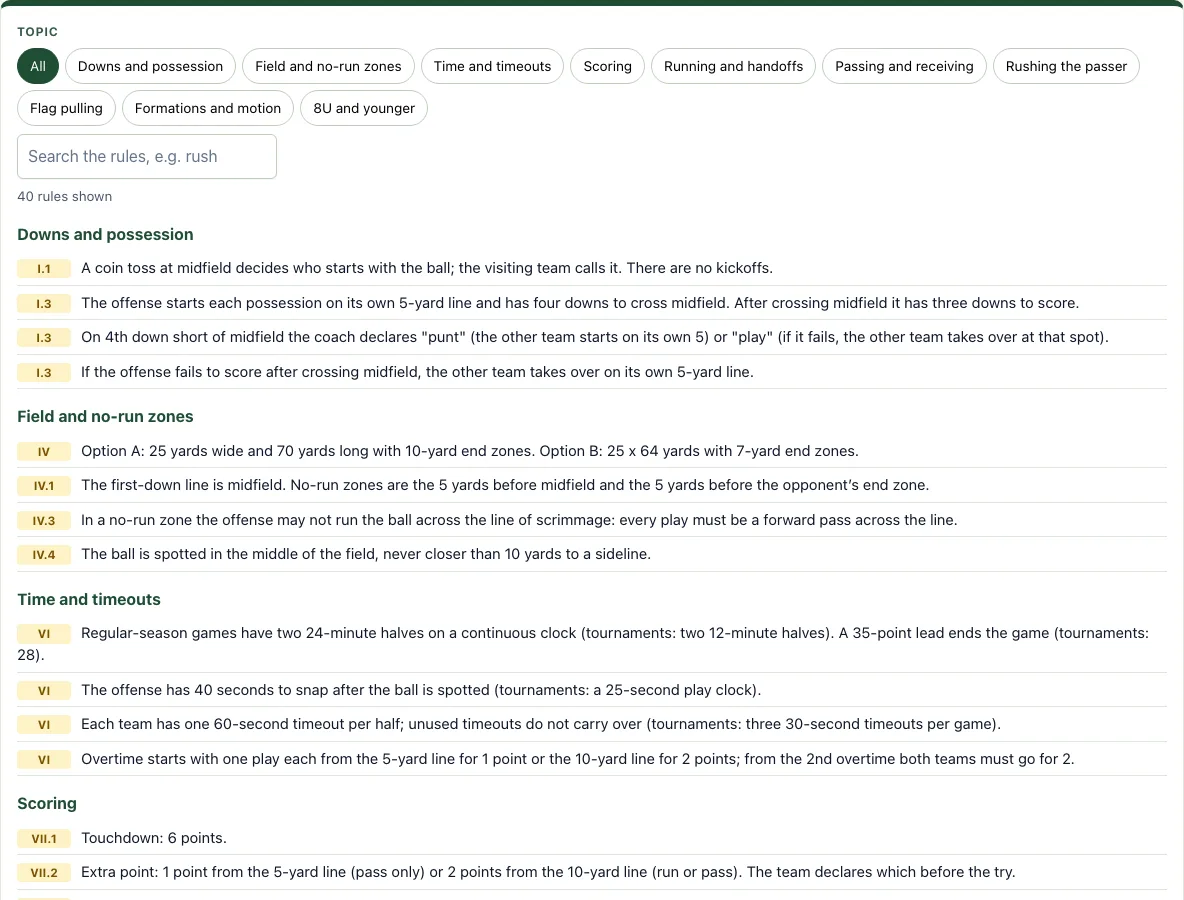
- I.1 A coin toss at midfield decides who starts with the ball; the visiting team calls it. There are no kickoffs.
- I.3 The offense starts each possession on its own 5-yard line and has four downs to cross midfield. After crossing midfield it has three downs to score.
- I.3 On 4th down short of midfield the coach declares "punt" (the other team starts on its own 5) or "play" (if it fails, the other team takes over at that spot).
- I.3 If the offense fails to score after crossing midfield, the other team takes over on its own 5-yard line.
Field and no-run zones
- IV Option A: 25 yards wide and 70 yards long with 10-yard end zones. Option B: 25 x 64 yards with 7-yard end zones.
- IV.1 The first-down line is midfield. No-run zones are the 5 yards before midfield and the 5 yards before the opponent’s end zone.
- IV.3 In a no-run zone the offense may not run the ball across the line of scrimmage: every play must be a forward pass across the line.
- IV.4 The ball is spotted in the middle of the field, never closer than 10 yards to a sideline.
Time and timeouts
- VI Regular-season games have two 24-minute halves on a continuous clock (tournaments: two 12-minute halves). A 35-point lead ends the game (tournaments: 28).
- VI The offense has 40 seconds to snap after the ball is spotted (tournaments: a 25-second play clock).
- VI Each team has one 60-second timeout per half; unused timeouts do not carry over (tournaments: three 30-second timeouts per game).
- VI Overtime starts with one play each from the 5-yard line for 1 point or the 10-yard line for 2 points; from the 2nd overtime both teams must go for 2.
Scoring
- VII.1 Touchdown: 6 points.
- VII.2 Extra point: 1 point from the 5-yard line (pass only) or 2 points from the 10-yard line (run or pass). The team declares which before the try.
- VII.3 An interception returned for a score is worth 6 points on a regular down and 2 points on an extra-point try or in overtime.
- VII.4 Safety: 2 points, when the ball carrier is downed in his own end zone.
Running and handoffs
- X.2 The quarterback (the player who takes the snap) may not run the ball across the line of scrimmage.
- X.3 Handoffs, pitches and laterals are allowed only behind the line of scrimmage. A "center sneak" is not allowed: the QB may not hand or pitch the ball to the center first.
- X.3 Once the ball has been handed off, pitched or lateraled, the 7-second pass clock ends and every defender may rush.
- X.6 Ball carriers may not jump, leap or hurdle to advance; the ball is spotted where they left the ground.
- X.8 No blocking or screening at any time.
Passing and receiving
- XI.1 One forward pass per play, thrown from behind the line of scrimmage; unlimited backward passes behind the line.
- XI.1 There is no intentional grounding, but a forward pass must cross the line of scrimmage.
- XI.3 The quarterback has 7 seconds to throw. If he has not thrown, the play is dead and the down counts.
- XII.1 Every player is an eligible receiver, including the quarterback after a handoff, pitch or lateral behind the line.
- XII.2 A receiver needs one foot (or other body part) in bounds, landing with possession.
Rushing the passer
- XIII.1 Rushers start at least 7 yards from the line of scrimmage, raise a hand before the snap and must go immediately at the snap. Up to two players may rush.
- XIII.1 Players who do not rush may line up anywhere and defend the line of scrimmage.
- XIII.4 A rusher may try to block a pass but may not contact the quarterback (roughing the passer).
- XIII.6 A sack: the quarterback’s flag is pulled behind the line. The ball is spotted where the flag was pulled.
Flag pulling
- XIV.2 Defenders may dive to pull a flag but may not tackle, hold or run through the ball carrier.
- XIV.3 Stripping or pulling the ball from the carrier is illegal.
- XIV.4 If a ball carrier’s flag falls off, he is down where the flag lands.
- XIV.7 Flag guarding is illegal: stiff-arming, lowering the head, hand, ball or shoulder, or covering the flags with the jersey.
Formations and motion
- XV.1 The offense has at least one player on the line (the center) and up to four on the line. The quarterback must be off the line.
- XV.3 The center snaps the ball between the legs in one continuous motion.
- XV Only one player may be in motion at the snap, moving parallel to or away from the line of scrimmage. All players must be set for one second after a shift.
8U and younger
- XVIII.a 8U / 2nd-3rd grade (league play): no-run zones are removed and defenders may not rush unless there is a handoff; one coach may be on the field before the snap.
- XVIII.b 7U and 6U / 1st grade and below: no-run zones removed, no rush unless there is a handoff, a dropped snap is a "do over" once per down, and defenders line up at least 5 yards off the ball (3 yards inside the 5-yard line).
- XIII.1 Regular-season 8U, 7U, 6U and 1st-3rd grade divisions: defenders may not rush the passer. Tournaments from 8U up: rushers may rush from the 7-yard line.
| Penalty | On | Yards | Result |
|---|---|---|---|
| Defensive pass interference | Defense | — | Automatic first down (spot foul) |
| Holding / illegal contact (defense) | Defense | +5 | Automatic first down (spot foul) |
| Stripping | Defense | +5 | Automatic first down (spot foul) |
| Offside / illegal substitution (defense) | Defense | +5 | Automatic first down |
| Illegal rush (inside the 7-yard marker) | Defense | +5 | Automatic first down |
| Illegal flag pull (before the catch) | Defense | +5 | Automatic first down |
| Roughing the passer | Defense | +5 | Automatic first down |
| Unnecessary roughness (defense) | Defense | +10 | Automatic first down |
| Unsportsmanlike conduct (defense) | Defense | +10 | Automatic first down |
| Taunting (defense) | Defense | +10 | Automatic first down |
| Screening or blocking | Offense | −5 | Loss of down (spot foul) |
| Charging | Offense | −5 | Loss of down (spot foul) |
| Flag guarding | Offense | −5 | Loss of down (spot foul) |
| Holding / illegal contact (offense) | Offense | −5 | Loss of down (spot foul) |
| Offside / false start / illegal substitution (offense) | Offense | −5 | Loss of down |
| Illegal forward pass | Offense | −5 | Loss of down |
| Offensive pass interference | Offense | −5 | Loss of down |
| Illegal motion (more than one player moving) | Offense | −5 | Loss of down |
| Delay of game | Offense | −5 | Loss of down |
| Impeding the rusher | Offense | −5 | Loss of down |
| Illegal procedure | Offense | −5 | Loss of down |
| Unnecessary roughness (offense) | Offense | −10 | Loss of down |
| Unsportsmanlike conduct (offense) | Offense | −10 | Loss of down |
| Taunting (offense) | Offense | −10 | Loss of down |
Source: NFL FLAG Official Playing Rules, revised 2025-03-24, read 2026-10-20. Summarised in our own words; your league's rules come first. nflflag.com
Recent
Your last 10 settings, saved only in this browser. Nothing is uploaded.
This flag football rules guide lists the 40 NFL FLAG 5v5 rules in plain English, so you can look up how to play flag football without reading the full rulebook. It is free, needs no sign-up and runs in your browser, and nothing is uploaded. Each rule has its section number and sits under a topic such as Downs and possession, Scoring or Flag pulling.
On this page you will also find a penalty table with 24 penalties and their yardage, plus a 12-question quiz you can check. The rules come from NFL FLAG Official Playing Rules, revised 2025-03-24. FlagPlayLab is not affiliated with the NFL, and local leagues may change rules, so check with your league before a game.
How to use the Flag Football Rules Tool
Use these steps to find a rule, check a penalty or test what you know.
- Click a topic button, such as Scoring or Flag pulling, to show only the rules in that group.
- Type a word into the search box to filter the list, for example “no-run” or “timeout”.
- Read a rule and note its section number so you can refer back to it quickly.
- Scroll to the penalty table to see each of the 24 penalties with its yards and result.
- Open the 12-question quiz, answer each question, and select Check my answers.
- Press Print under the quiz for a paper copy of the rules, the penalty table and the quiz. Press Start again to clear your answers.
Each rule keeps the section number of the official rulebook (for example XIII.1 for rushing), so you can look up the full wording in the NFL FLAG PDF linked at the bottom of the list.
Topic buttons and the search box work together, and the count under them says how many rules are shown.
The quiz answers come only from the rules list on this page, and after you press Check my answers each question shows the right answer and its rule number.
How do you play flag football?
NFL FLAG football is played 5 on 5, and the defense stops the ball carrier by pulling a flag from his belt instead of tackling him. Each play starts with five players on each side lining up, then the ball is snapped and the quarterback either throws the ball or hands it off.
A coin toss decides the start of the game, and there are no kickoffs. Each possession starts on the offense’s own 5-yard line, so the offense begins every drive with a short field to cover. Players cannot block, which keeps the play focused on speed, passing and pulling flags.
What are the basic rules of flag football?
The basic rules control how the ball moves, how many chances a team gets and how the clock runs. A team has four downs to cross midfield, then three downs to score once it has crossed. Only one forward pass is allowed on a play, and handoffs and pitches must happen behind the line of scrimmage.
The field is 25 yards wide and 70 yards long with 10-yard end zones under Option A, or 64 yards long with 7-yard end zones under Option B. Regular-season games have two 24-minute halves and one 60-second timeout per half. A 35-point lead ends the game early.
Penalties are part of the basic rules too. Flag guarding, for example, costs 5 yards and a loss of down. Check the penalty table on this page for the other 23 penalties and their results.
How do penalties work in flag football?
Offensive penalties cost yards and the down: most are 5 yards and a loss of down, and unnecessary roughness, unsportsmanlike conduct and taunting are 10. Defensive penalties give the offense yards and an automatic first down; pass interference is a spot foul with an automatic first down. Spot fouls are marked from where they happen, the rest from the line of scrimmage, and a penalty never moves the ball more than half the distance to the goal.
Frequently asked questions
Can the quarterback run in flag football?
Not across the line. The quarterback has 7 seconds to throw and cannot run the ball across the line. The quarterback can still hand off or pitch the ball behind the line.
How far back do rushers start?
Rushers start 7 yards back from the line, and up to two rushers can do this. Each rusher must raise a hand before the snap.
How many points is a touchdown and an extra point?
A touchdown is worth 6 points. An extra point is worth 1 point from the 5-yard line (pass only) or 2 points from the 10-yard line (run or pass). There are no kicks. A safety is worth 2 points, and an interception return is worth 6 points, or 2 on an extra-point try.
What is a no-run zone?
A no-run zone is the 5 yards before midfield and the 5 yards before the goal line. From there the offense may not run the ball across the line of scrimmage: every play must be a forward pass across the line. Leagues for 8U and younger remove the no-run zones.
Is it free and do I need an account?
Yes, the tool is free and needs no sign-up. It runs in your browser, and nothing you do is uploaded.
Does it work on a phone or tablet?
Yes. The rules list, the quiz and the penalty table fit a phone screen; the table scrolls sideways inside its own box.
Related tools
- Flag football positions: Use this when you want to learn what each player does on the field.
- Flag football field dimensions: Use this when you need the exact field size and end zone depth for Option A or Option B.
- 5v5 flag football plays: Use this when you want plays to try with a five-player team.
- Flag football defense: Use this when you are working on how to stop the offense and pull flags.
- Flag football drills: Use this when you want practice exercises for passing, handoffs or flag pulling.
- Youth flag football plays: Use this when you are coaching younger players and need simpler plays.
- Football play designer: Use this when you want to draw and set up your own play.