
Football Formations
37 offensive and defensive formations for flag and 11-man football. Print them or edit any one.
Spread
Receivers spread to both sidelines: the defense has to cover the whole width of the field.
Twins
Two receivers on the same side.
Stack
Two receivers lined up one behind the other, so the defenders have to decide who takes whom.
Shotgun with a Back
Quarterback in the shotgun with a back beside him for handoffs, pitches and swing passes.
Spread
Receivers spread to both sidelines: the defense has to cover the whole width of the field.
Trips
Three receivers to one side. Good for flood and stick concepts; the single receiver gets one-on-one coverage.
Bunch
Three receivers tight together. Hard to press, and their routes cross naturally.
Stack
Two receivers lined up one behind the other, so the defenders have to decide who takes whom.
Shotgun with a Back
Quarterback in the shotgun with a back beside him for handoffs, pitches and swing passes.
I Formation
A back directly behind the quarterback: the base for dives, counters and play-action.
Spread
Receivers spread to both sidelines: the defense has to cover the whole width of the field.
Trips
Three receivers to one side. Good for flood and stick concepts; the single receiver gets one-on-one coverage.
Bunch
Three receivers tight together. Hard to press, and their routes cross naturally.
Stack
Two receivers lined up one behind the other, so the defenders have to decide who takes whom.
Shotgun with a Back
Quarterback in the shotgun with a back beside him for handoffs, pitches and swing passes.
Spread
Receivers spread to both sidelines: the defense has to cover the whole width of the field.
Trips
Three receivers to one side. Good for flood and stick concepts; the single receiver gets one-on-one coverage.
Bunch
Three receivers tight together. Hard to press, and their routes cross naturally.
Empty
No back in the backfield: five or more receivers spread out.
Stack
Two receivers lined up one behind the other, so the defenders have to decide who takes whom.
Spread
Receivers spread to both sidelines: the defense has to cover the whole width of the field.
Trips
Three receivers to one side. Good for flood and stick concepts; the single receiver gets one-on-one coverage.
I Formation
A back directly behind the quarterback: the base for dives, counters and play-action.
Empty
No back in the backfield: five or more receivers spread out.
I Formation
Quarterback under center with the fullback and tailback in a line behind him: a downhill running formation.
Shotgun
Quarterback five yards deep with the back beside him: more time to read and throw.
Singleback
Quarterback under center with one back behind him and three receivers.
Pistol
Shotgun at a shorter depth with the back directly behind the quarterback.
Spread
Receivers spread to both sidelines: the defense has to cover the whole width of the field.
Trips
Three receivers to one side. Good for flood and stick concepts; the single receiver gets one-on-one coverage.
Wing-T
A tight end, a wingback just outside him and three backs: built for misdirection runs.
Double Wing
Two tight ends and two wingbacks: an unbalanced-looking power formation popular in youth football.
4-3 Defense
Four linemen and three linebackers: balanced against run and pass.
3-4 Defense
Three linemen and four linebackers; the outside linebackers can rush or drop.
4-4 Defense
Eight players near the line: strong against the run, one deep safety.
5-3 Defense
Five linemen and three linebackers, a common youth front against running teams.
6-2 Defense
Six linemen and two linebackers: crowds the line against inside runs.
Recent
Your last 10 settings, saved only in this browser. Nothing is uploaded.
Football formations are the pre-snap setups that show where each player lines up before the ball is snapped. This page brings together 37 formation diagrams for flag football, 11-a-side offense and five defensive fronts, so you can compare offensive football formations side by side and see how each one is drawn.
Each diagram follows the same key, so once you learn the symbols you can read any football formations diagram on the page. The collection covers 4v4, 5v5, 6v6, 7v7 and 8v8 flag formats along with the full 11-player offense. It works well for coaches planning a practice, players learning their spots, and parents trying to follow what the coach is calling. Use the filters and search box to narrow the list to the formations you need.
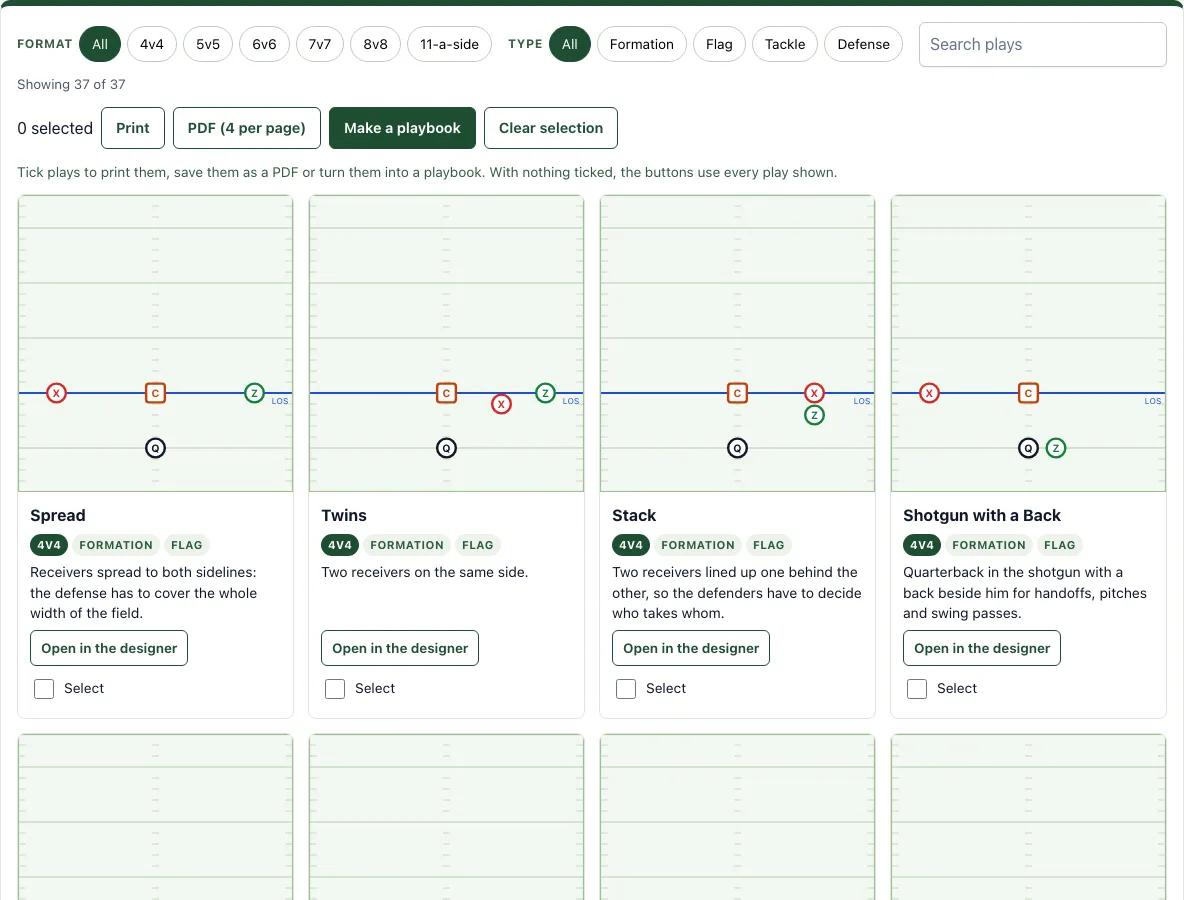
How to use the Football Formations tool
- Scroll to the filter buttons above the cards. Choose a format (4v4 to 8v8 flag, or 11-a-side) or a type (Flag, Tackle or Defense).
- Type a formation name, such as “Trips” or “Pistol”, into the search box. The count under the filters shows how many formations match.
- Read a card: the diagram, the formation name, its format and type tags, and a short note on what the formation is for.
- To study one diagram in depth, press “Open in the designer” on its card. You can change the player positions there.
- To build a set of formations, tick the Select box on each card you want.
- Press “Make a playbook” to open the playbook maker with your selected plays.
- Press Print or PDF to get a printout. PDF prints four plays per page. If you have not selected any cards, Print and PDF include every play currently shown, so apply your filters first.
The plays you tick stay ticked in this browser, so you can come back later and print the same set. Open in the designer loads a formation with no routes, ready for you to draw your own.
Each card prints with its diagram and note.
What are the basic football formations?
Basic football formations describe how the offense spreads its players before the snap. Most of them are built from the same parts: the quarterback, the running backs, the tight ends and the receivers. The difference between formations is where those players stand and how many of each position are on the field.
The 11-a-side offense on this page includes I formation, Shotgun, Singleback, Pistol, Spread, Trips, Wing-T and Double wing. Singleback has one back behind the quarterback. Spread puts receivers out to both sidelines. Trips puts three receivers on one side of the formation. Wing-T uses a tight end, a wingback just outside him and three backs. Double wing adds a second tight end and a second wingback. In flag football, you will see Bunch as well, where three receivers stand tight together.
What is the I formation?
The I formation is a running set in which the quarterback lines up directly under the center. The fullback and tailback stand in a straight line behind him, which gives the formation its name. Because the backs are lined up in a column, the quarterback can hand off to either one with a short, simple exchange.
The I formation is a common base for running plays because the backs are close to the line and can hit a gap quickly. It is also a good starting point for learning how formations connect to plays. Look at its diagram to see where the backs stand, then compare it with a Shotgun diagram to see how moving the quarterback changes the picture.
What is a Wing-T formation?
The Wing-T puts a tight end on the line, a wingback just outside and behind him, and three backs in the backfield. It is built for misdirection: the backs fake one way and run the other, as in our Buck Sweep play, where both guards pull to lead the halfback around the end.
Frequently asked questions
What are common youth defensive fronts?
A defensive front is the way the defense lines up its linemen and linebackers against the offense. The numbers name the line first, then the linebackers, so 4-3 means four linemen and three linebackers, and 3-4 means three linemen and four linebackers. Youth teams often use 5-3 or 6-2 against running teams, because these fronts crowd the line and make it harder for a runner to gain yards.
What is the difference between shotgun and pistol?
Both formations put the quarterback further back than under center. In the shotgun, the quarterback sits about five yards deep with the running back beside him. In the pistol, the quarterback stands a bit closer to the line with the running back directly behind him, so the handoff and the fake are shorter.
Is it free and do I need an account?
Yes, the tool is free and needs no sign-up. It runs in your browser, and nothing you do is uploaded.
Can I print it or save it as a PDF?
Yes. Select the plays you want and press Print or PDF. The PDF option puts four plays on each page. If nothing is selected, the printout includes every play that matches your current filters.
Does it work on a phone or tablet?
Yes. The play cards stack in one column on a phone, and Open in the designer lets you change any play with your finger.
Do the flag football formations follow the rules?
Yes. Every flag formation passes our rule check built from the NFL FLAG 5v5 formation rule: the center is on the line, no more than four players are on it, and the quarterback lines up off it. All diagrams are our own drawings of common alignments.
Related tools
- Youth football plays: Use it when you are coaching young players and want simple plays with a youth focus.
- Football play maker: Use it when you want to build a play from scratch after choosing a formation.
- All flag football plays: Use it when you need the full flag library to compare plays across formats.
- Flag football positions: Use it when you want to learn what each player does in a flag formation.
- Football play designer: Use it when you want to edit a diagram or draw your own play.
- Football field diagram: Use it when you need a blank field to sketch alignments on.