
Football Route Tree
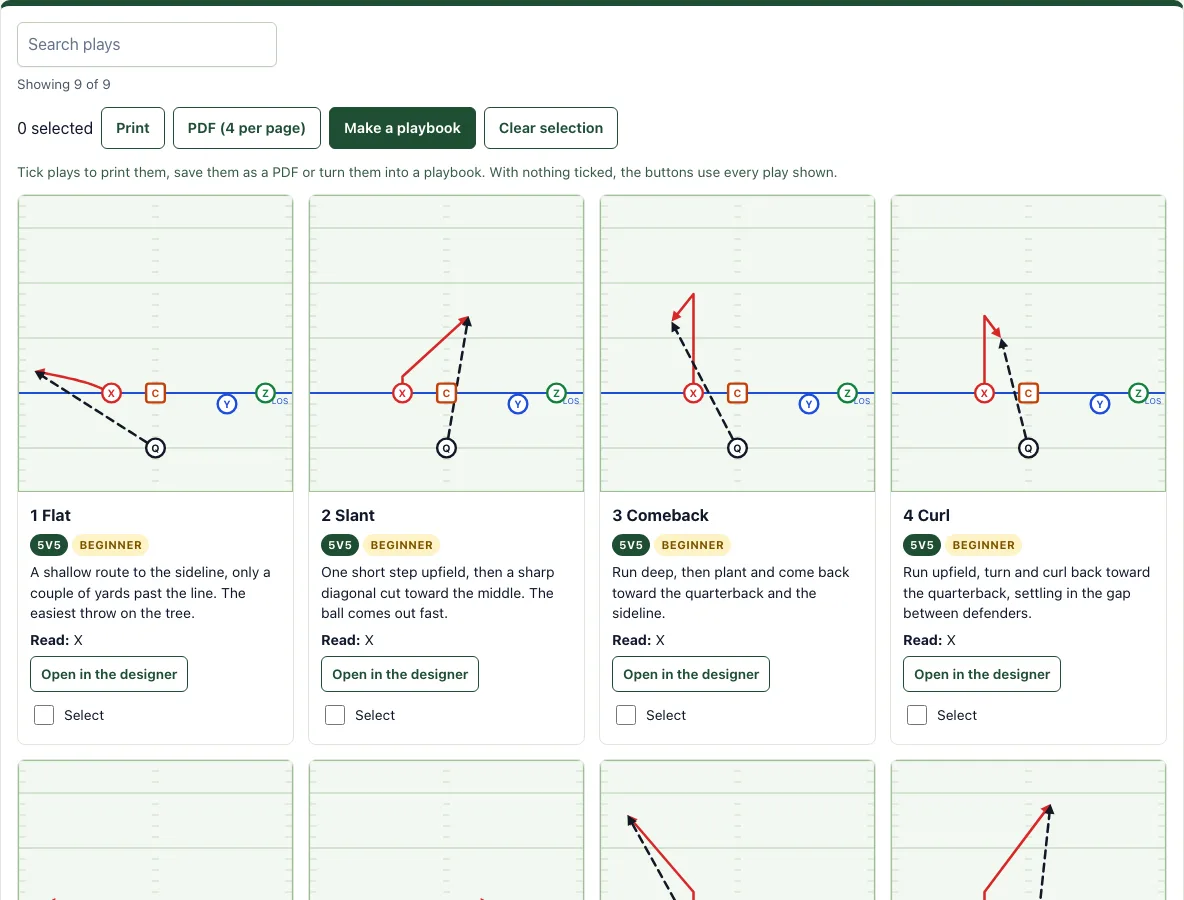
The nine routes every receiver learns, numbered and drawn on a field. Print them or open one to edit.
1 Flat
A shallow route to the sideline, only a couple of yards past the line. The easiest throw on the tree.
Read: X
2 Slant
One short step upfield, then a sharp diagonal cut toward the middle. The ball comes out fast.
Read: X
3 Comeback
Run deep, then plant and come back toward the quarterback and the sideline.
Read: X
4 Curl
Run upfield, turn and curl back toward the quarterback, settling in the gap between defenders.
Read: X
5 Out
Run straight, then cut square to the sideline.
Read: X
6 In (Dig)
Run straight, then cut square across the field toward the middle.
Read: X
7 Corner
Run upfield, then break diagonally to the corner of the field.
Read: X
8 Post
Run upfield, then break diagonally toward the middle of the field, the way a goalpost stands.
Read: X
9 Go (Fly)
Straight up the field as fast as you can. The deepest route on the tree.
Read: X
Free · runs in your browser · nothing is uploaded
Recent
Your last 10 settings, saved only in this browser. Nothing is uploaded.
How to use the football route tree
- Look at the nine cards. Each shows one receiver (X) running one route, with its number, name and a short description.
- Read the shape of the arrow. The receiver starts on the line of scrimmage, and the arrow shows the path he runs.
- Tick the Select box on a card to keep it. The ticked routes stay ticked in this browser.
- Press Print or PDF. If nothing is ticked, every route shown is used, so you get the whole tree on a sheet.
- Press Make a playbook to send the ticked routes to the playbook maker, where you can add them to a team book.
- Press Open in the designer on a card to change the route depth or put it on another receiver, then save or print the new play.
Use the printed sheet at practice: hand it to receivers so that “post” and “8” mean the same thing to everybody, then quiz them by calling a number and having them run the route. Start with three or four routes, add more each week, and keep the printed tree in the team folder so a new player can learn the numbers on their own.
What are the 9 routes on the football route tree?
This page uses the most common 1 to 9 route tree: 1 flat, 2 slant, 3 comeback, 4 curl, 5 out, 6 in (also called a dig), 7 corner, 8 post and 9 go. Routes 1 and 2 are quick, short throws and 9 is the deep route; routes 3 to 8 are the in-between cuts, and the exact depth of each is the coach’s call.
- 1 Flat: a shallow run to the sideline.
- 2 Slant: one short step, then a sharp diagonal cut toward the middle.
- 3 Comeback: run deep, then plant and return toward the quarterback.
- 4 Curl: run upfield, then turn back toward the quarterback.
- 5 Out: run straight, then cut square toward the sideline.
- 6 In (dig): run straight, then cut square toward the middle.
- 7 Corner: run upfield, then break diagonally toward the corner.
- 8 Post: run upfield, then break diagonally toward the middle of the field.
- 9 Go: run straight up the field.
What do the odd and even route numbers mean?
Odd-numbered routes generally break toward the sideline, and even-numbered routes break toward the middle of the field or back toward the quarterback. Go (9) is the exception because it runs straight up the field. This is a teaching convention, so check the playbook your team uses.
Routes that break outside are flat (1), comeback (3), out (5) and corner (7). Routes that break inside or back toward the quarterback are slant (2), curl (4), in or dig (6) and post (8).
The numbering is not a rule. Teams change it, and some route trees add routes such as seam or wheel. Each route on this page appears as a diagram with its number, name and a one-line description, so you can confirm what a number means in the tree you are using. The depths on the diagrams are scaled to a 5v5 NFL FLAG field, which is 25 yards wide and 50 yards between the goal lines. Eleven-player teams often break these routes at 10 to 15 yards. NFL FLAG and USA Football rules do not set route numbers, so each team chooses its own.
How do you call routes in a play?
Coaches call routes by naming each receiver or position, followed by a route number. For example, “X 4, Z 8, slot 2” means X runs a curl, Z runs a post, and the slot runs a slant on this tree. Each receiver runs one route.
The route tree only sets which route each number means. The coach decides the quarterback’s read order and how deep each route cuts, in steps or yards. On flag football wristbands and call sheets, write the route name beside its number so a player who forgets the numbering can still read the play.
Are route numbers the same on every team?
No. The nine-route tree is a common teaching tool, but numbers differ from team to team and some trees skip routes or add others, such as a seam or a wheel. Tell your players which numbering you use. On wristbands and call sheets, write the route name next to the number.
How do you read a route tree?
Read it from the receiver’s starting spot. The number tells you which route to run, and the shape shows where the receiver stops going straight and cuts. On our diagrams the receiver starts on the line of scrimmage and the solid arrow shows the path. Whether a route breaks toward the sideline or the middle is the same on the left and right side of the field, only mirrored.
Which routes should young players learn first?
Start with routes that need one cut and little depth: flat, slant, out and go. Add curl and comeback once players can catch and turn, and teach corner, post and in last. This order is our coaching suggestion, not a rule.
Frequently asked questions
Is it free and do I need an account?
Yes. The tool is free, needs no sign-up and runs in your browser.
Can I print it or save it as a PDF?
Yes. Tick the routes you want, then press Print or PDF. If nothing is ticked, both buttons use every route shown.
Does it work on a phone or tablet?
Yes. The route cards stack in one column on a phone, and Open in the designer lets you change a route with your finger.
How many routes are on a football route tree?
Nine in the version shown here. Other trees have more, so use the numbering your team agrees on.
Can I change the depth of a route?
Yes. Open the route in the designer and edit it there. The card on this page does not change.
Can I use what I make here commercially?
Yes. Sheets, cards, diagrams and PDFs you make with this tool are yours to print, hand out, sell or put in your own products, such as a coaching book on KDP or a printable on Etsy, with no credit needed. You may not copy the tool or the site itself; see the terms.
Related tools
- 4v4 Flag Football Plays — 6 plays for 4 on 4 flag football with diagrams and reads. Print them or open any play to edit
- 5v5 Flag Football Plays — 14 plays for 5 on 5 flag football, checked against the NFL FLAG rules. Print them or edit any play
- 6v6 Flag Football Plays — 8 plays for 6 on 6 flag football with diagrams and reads. Print them or open any play to edit
- 7 on 7 Flag Football Plays (7v7) — 9 plays for 7 on 7 with diagrams and reads. Print them or open any play to edit
- 8v8 Flag Football Plays — 7 plays for 8 on 8 flag football with diagrams and reads. Print them or open any play to edit
- Flag football playbook PDF — Print the routes as part of a team playbook.
- Flag Football Defense — 14 flag football defenses drawn with zones, rushers and coverage. Print them or edit any one
- Flag Football Plays — 44 flag football plays with diagrams and reads. Filter by format, print them or open any play to edit
- Football Formations — 37 offensive and defensive formations for flag and 11-man football. Print them or edit any one