
Can You Block in Flag Football?
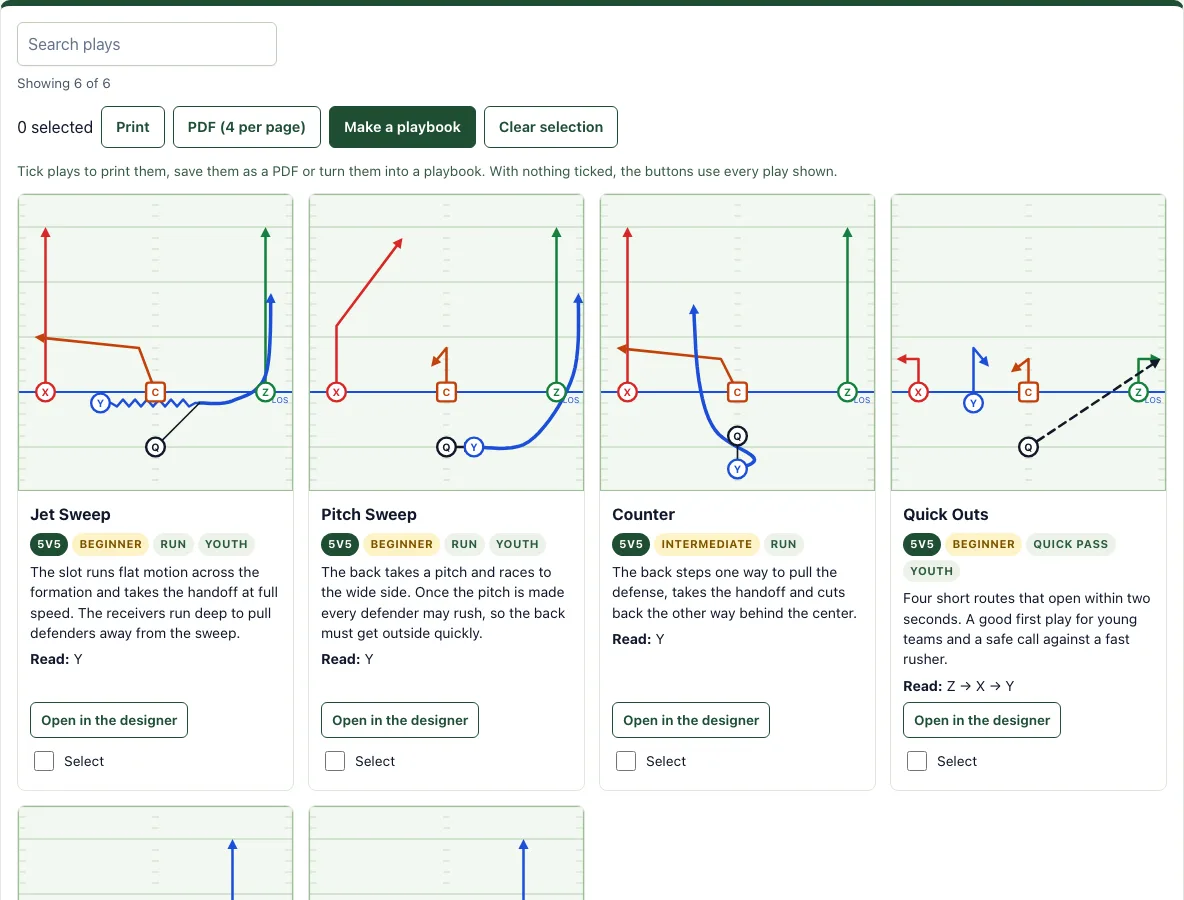
No. NFL FLAG rule X.8 bans blocking and screening at any time. A screening or blocking foul costs the offense 5 yards and a loss of down, and intentional blocking can get a player ejected. Teams create space with motion, handoffs and quick routes instead, as the six plays below show.
Jet Sweep
The slot runs flat motion across the formation and takes the handoff at full speed. The receivers run deep to pull defenders away from the sweep.
Read: Y
Pitch Sweep
The back takes a pitch and races to the wide side. Once the pitch is made every defender may rush, so the back must get outside quickly.
Read: Y
Counter
The back steps one way to pull the defense, takes the handoff and cuts back the other way behind the center.
Read: Y
Quick Outs
Four short routes that open within two seconds. A good first play for young teams and a safe call against a fast rusher.
Read: Z → X → Y
Slant Flat
Z runs a 3-step slant, the inside man runs to the flat underneath him. If the defender on Z sits inside, throw the flat.
Read: Z → X → C
Stack Out and Up
The front man in the stack runs straight up and takes the defender with him; the back man breaks out at 4 yards into the space left behind.
Read: Z → Y → X
Free · runs in your browser · nothing is uploaded
Recent
Your last 10 settings, saved only in this browser. Nothing is uploaded.
How to use the tool on this page
- Look at the six cards. Every player is either a runner, a receiver or a decoy, and none is asked to block.
- Read the note on each card to see how it makes space without contact.
- Tick the Select box on the plays you want to keep.
- Press Print or PDF to put the ticked plays on a sheet. With nothing ticked, all six print.
- Press Open in the designer on a card to change a route or add a note for your team, then save or print it.
Teach your players the no-contact habit early: run your route, do not stop to shield a defender, and if the ball is thrown to a teammate keep moving away from the play. A good drill is to run each play in practice with a coach shouting “no hands” whenever two players get close. On a phone the cards stack in one column with the buttons under each card, and on a desktop they sit in a grid. Printed sheets keep their labels in black and white, so they photocopy cleanly for assistant coaches. Your ticked cards and edits stay in this browser only; nothing is uploaded, and clearing the site data removes them. Use the Select boxes before printing if you only want part of the set, and print one sheet per position group for a clean handout.
Can you block in flag football?
No. Under NFL FLAG rule X.8, blocking and screening are not allowed at any time, so an offensive player cannot use their body to shield a teammate or the ball carrier from a defender. Flag football replaces tackles with flag pulls, and the rules keep physical contact to a minimum.
Several rules back this up:
- Offensive players may not initiate contact with defenders at the line of scrimmage.
- Defenders must give receivers a free release off the line, and offensive players may not start contact with a defender there (section XVI).
- Once the ball crosses the line of scrimmage, nearby offensive players must stop their motion. Nobody can run alongside the carrier as a blocker (rule X.9).
- The offense may not impede the rusher’s path to the quarterback (rule XIII.5).
What happens if you block in flag football?
In flag football, blocking is not allowed. If an offensive player screens or blocks, the officials call a spot foul: the offense is moved back 5 yards and loses the down. Charging, flag guarding, holding, and illegal contact by the offense carry the same penalty.
| Foul | Penalty |
|---|---|
| Screening or blocking (offense) | 5 yards back, loss of down |
| Impeding the rusher | 5 yards from the line of scrimmage, loss of down |
| Unsportsmanlike conduct | 10 yards |
Blocking can also lead to bigger consequences. If officials see intentional blocking, tackling, elbowing, or any other unsportsmanlike act, they can stop the game and eject the player at their discretion. Two unsportsmanlike conduct penalties on the same player or coach result in disqualification.
How do offenses make space without blocking?
Offenses create space by moving players in ways that pull defenders out of position before the ball is handed or thrown. Motion, misdirection, quick passes, and route spacing each make a defender commit to one spot, which leaves room somewhere else.
Motion is one method. One player may move parallel to or away from the line before the snap, so defenders have to adjust. The Jet Sweep uses this to bring the slot across at speed for the handoff.
Misdirection makes the defense react to a false read. In the Counter, the back steps one way to draw defenders, then cuts back the other way behind the center.
Quick throws leave less time for pressure to arrive. The Quick Outs play gives the quarterback four short routes that open within two seconds, so the pass is out before a defender gets close.
Route spacing splits the coverage. In Stack Out and Up, the front receiver runs deep and takes his defender with him, opening space for the back man to break out.
Are pick plays legal in flag football?
No, a pick play is not legal when the offense deliberately stops or screens a defender. The NFL FLAG rulebook never uses the word “pick,” but it bans blocking and screening, and a deliberate screen is a foul.
Crossing routes are a different case. They are legal when each receiver keeps running his own route. A receiver may not stop, slow down or set himself in a defender’s path to free a teammate, with or without contact.
Watch for these fouls:
- Holding or illegal contact by the offense, both 5-yard fouls.
- Stopping or setting yourself in a defender’s path on purpose to free a teammate.
If two players collide without intent, officials decide whether the contact was incidental.
How this tool works and where the numbers come from
Blocking rules and penalties come from sections X, XIII, XIV, XVI and XVII of the NFL FLAG playing rules. The six plays are drawn by our play engine, which flags any play that uses a block or screen action. It does not detect contact between players, so the coach has to check crossing routes.
Sources
- NFL FLAG, Official Playing Rules (revised 2025-03-24) · checked
Frequently asked questions
Can you block in girls or youth flag football?
Under NFL FLAG rules the ban applies to every division. The younger-division changes in section XVIII relax running and rushing rules, not blocking. Other organizations may word it differently, so check your league rule sheet.
Can you pick or screen a defender in flag football?
No. Screening is a foul, with or without contact. Routes may cross as long as each receiver keeps running his own route and nobody stops in a defender’s path.
Is stiff-arming allowed in flag football?
No. Stiff-arming is flag guarding, an offensive foul that costs 5 yards and a down (rules XIV.7 and XVII).
Can a ball carrier run into a defender?
Not intentionally. Charging, when a ball carrier runs directly into a set defender, is a 5-yard penalty and loss of down.
Does it work on a phone or tablet?
Yes. The layout fits a phone, and you can print or save a PDF from the browser, then keep the sheet in your coaching bag.
Is it free and do I need an account?
Yes, it is free, needs no sign-up and runs in your browser.
Can I use what I make here commercially?
Yes. Sheets, cards, diagrams and PDFs you make with this tool are yours to print, hand out, sell or put in your own products, with no credit needed. You may not copy the tool or the site itself; see the terms.
Related tools
- Flag Football Rules — The NFL FLAG 5v5 rules in plain words, with section numbers, a penalty table and a quiz
- 5v5 Flag Football Plays — 14 plays for 5 on 5 flag football, checked against the NFL FLAG rules. Print them or edit any play
- Trick Plays Flag Football — Reverse, flea flicker, hitch and go and other trick plays drawn for 5v5
- Youth Flag Football Plays — Simple flag football plays for younger teams, with diagrams to print or edit
- Football Play Maker — Draw 11-on-11 plays with blocks, runs and defenses and print or share them
- Can You Rush in Flag Football? — Yes, up to two defenders from 7 yards in NFL FLAG, except in younger divisions
- Flag Football Playbook — Collect plays into a team playbook and print it or save it as a PDF
- Flag Football Practice Plan — Build a timed practice plan by length, age group and focus