
How Do You Beat Man Coverage in Flag Football?
Make each defender run a long way to stay with his receiver: crossing routes at different depths, a stack that sends the front man deep, a double move, or a quick slant with a flat underneath. Receivers run their own routes and never move into a defender's path, because screening is a foul.
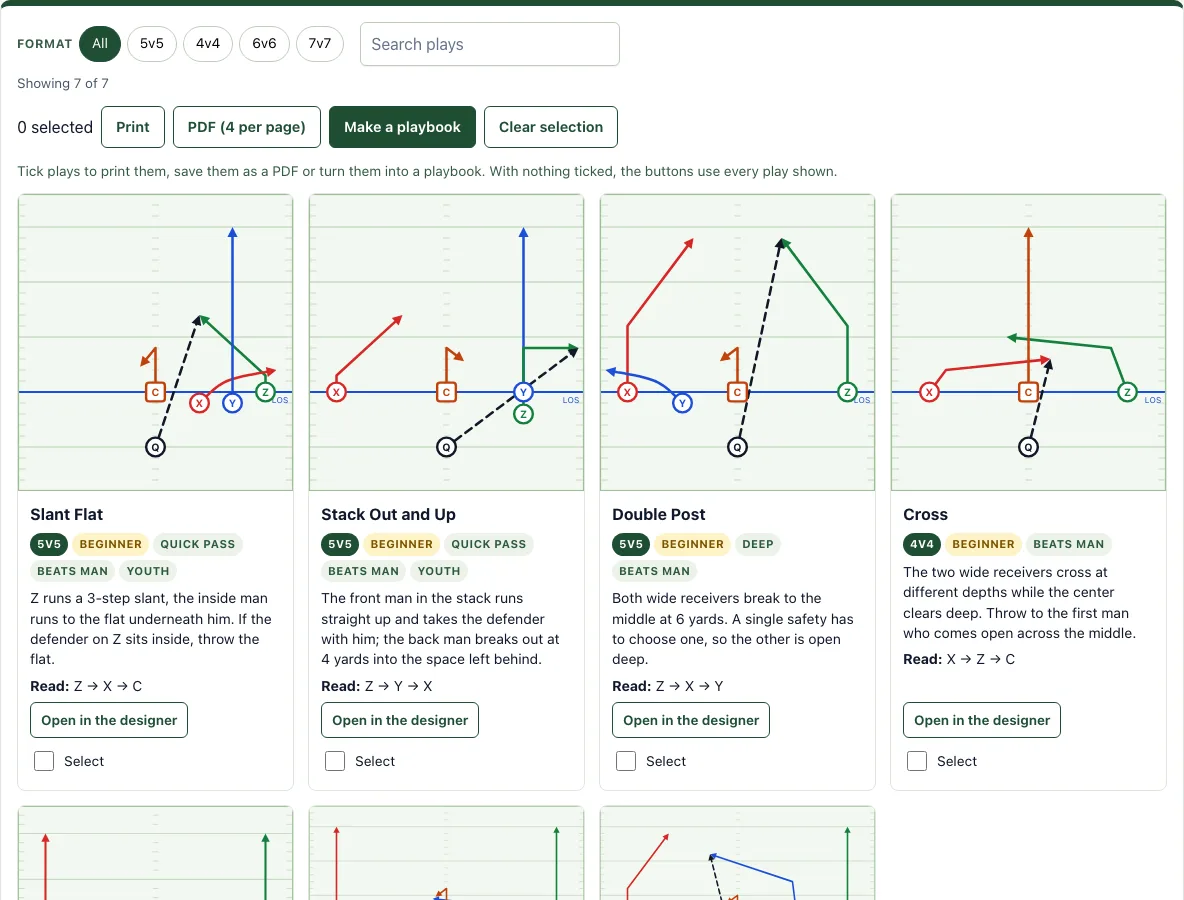
Slant Flat
Z runs a 3-step slant, the inside man runs to the flat underneath him. If the defender on Z sits inside, throw the flat.
Read: Z → X → C
Stack Out and Up
The front man in the stack runs straight up and takes the defender with him; the back man breaks out at 4 yards into the space left behind.
Read: Z → Y → X
Double Post
Both wide receivers break to the middle at 6 yards. A single safety has to choose one, so the other is open deep.
Read: Z → X → Y
Cross
The two wide receivers cross at different depths while the center clears deep. Throw to the first man who comes open across the middle.
Read: X → Z → C
Mesh
The two slots cross underneath while the outside men run deep. The center sits in the middle when the defense chases the crossers.
Read: H → Y → C
Mesh
Crossing slots under two deep routes, with the back swinging out as the last option.
Read: H → Y → F
Y Cross
The slot crosses the whole field at 7 to 11 yards while the outside receivers clear deep.
Read: Y → H → F
Free · runs in your browser · nothing is uploaded
Recent
Your last 10 settings, saved only in this browser. Nothing is uploaded.
How to use the tool on this page
- Pick your format with the chips above the cards, or leave them on All.
- Read the note on each card. It tells you who the quarterback should look at first.
- Tick the Select box on the plays you want to keep.
- Press Print or PDF to put the ticked plays on a sheet. With nothing ticked, every play shown prints.
- Press Open in the designer on a card to change a route or move a receiver, then save or print it.
Look for man coverage on the first drive: if each defender follows one receiver and runs with a player in motion, it is man. Then call a crossing play or a stack, and make sure each receiver keeps running his own route and never stops or sets himself in a defender’s path. On a phone the cards stack in one column with the buttons under each card, and on a desktop they sit in a grid. Printed sheets keep their labels in black and white, so they photocopy cleanly for assistant coaches. Your ticked cards and edits stay in this browser only; nothing is uploaded, and clearing the site data removes them. Use the Select boxes before printing if you only want part of the set, and print one sheet per position group for a clean handout.
How do you know if the defense is playing man?
In man coverage, each defender sticks to one receiver across the field instead of guarding an area. The quickest test is to watch what happens when an offensive player goes in motion before the snap.
- Find the player in motion and note the defender lined up across from him.
- If that defender runs with him across the field, the defense is probably in man.
- If defenders pass him to a teammate, the defense is in zone.
A typical man setup has one rusher pressuring the quarterback and a safety who takes the center. The Man to Man defense card on the Flag Football Defense page shows this layout.
How do you beat man coverage in flag football?
Beat man coverage with routes that make a defender run a long way to stay with his receiver or choose between two threats. When he has to follow a crossing route across the field or bite on a double move, the quarterback gets a clear throw. These four plays do that.
- Slant Flat: Z runs a 3-step slant while the inside man runs to the flat underneath him. If the defender on Z sits inside, throw the flat.
- Stack Out and Up: The front man runs straight up and takes his defender with him. The back man breaks out at 4 yards into the space left behind.
- Double Post: Both wide receivers break to the middle at 6 yards. A single safety has to pick one, so the other is open deep.
- Cross, Mesh, or Y Cross: The receivers cross at different depths, so a defender must run the whole crossing route to stay with his man.
Are pick plays legal against man coverage?
No. A pick is illegal. NFL FLAG rule X.8 bans screening at any time, with or without contact, and a screening foul costs 5 yards and a loss of down. Crossing routes are legal when each receiver keeps running his own route; a receiver may not stop, slow down or set himself in a defender’s path to free a teammate.
To keep a crossing play legal:
- Run the two crossing receivers at different depths so they pass each other without stopping.
- Never let a receiver step into, stop in or slow down in a defender’s path.
- Teach every receiver to finish his own route even when the ball goes elsewhere.
How should the receivers be set up for man coverage?
Set receivers in stacked or bunched formations so they release off the line in different directions. That keeps a defender from simply following the player in front of him. Stay legal at the line: receivers are owed a free release, and they may not start contact with a defender there.
- Stack or bunch the receivers so their routes break off the line in different directions.
- If you send a player in motion, use only one, and have him move parallel to or away from the line at the snap.
- Keep your hands off the defender at the line. Contact that you start there is a foul, because the defender must give you a free release.
How this tool works and where the numbers come from
Each play is drawn by our play engine and checked against the NFL FLAG rules for motion, passing and the line of scrimmage. The blocking and screening point comes from rule X.8 and section XVII; the reads are coaching guidance, not rules.
Sources
- NFL FLAG, Official Playing Rules (revised 2025-03-24) · checked
Frequently asked questions
Do crossing routes work against man coverage?
Yes. A defender has to run the whole crossing route to stay with his man. Cross at different depths and keep running your own route; never stop in a defender’s path.
How do you beat man coverage with a young team?
Start with Slant Flat or Stack Out and Up. Each has one clear read and short routes, so the quarterback has an easy decision.
What is a double move in flag football?
A route with two moves, such as a hitch and then a go, that makes the defender jump the first move. See the Trick Plays page for examples.
Does it work on a phone or tablet?
Yes. The layout fits a phone, and you can print or save a PDF from the browser, then keep the sheet in your coaching bag.
Is it free and do I need an account?
Yes, it is free, needs no sign-up and runs in your browser.
Can I use what I make here commercially?
Yes. Sheets, cards, diagrams and PDFs you make with this tool are yours to print, hand out, sell or put in your own products, with no credit needed. You may not copy the tool or the site itself; see the terms.
Related tools
- 5v5 Flag Football Plays — 14 plays for 5 on 5 flag football, checked against the NFL FLAG rules. Print them or edit any play
- 6v6 Flag Football Plays — 8 plays for 6 on 6 flag football with diagrams and reads. Print them or open any play to edit
- 7 on 7 Flag Football Plays (7v7) — 9 plays for 7 on 7 with diagrams and reads. Print them or open any play to edit
- Flag Football Defense — 14 flag football defenses drawn with zones, rushers and coverage. Print them or edit any one
- How Do You Beat a Zone Defense in Flag Football? — How to beat a zone defense in flag football: send two receivers at one defender with Flood, Smash, Curl Flat and more
- Trick Plays Flag Football — Reverse, flea flicker, hitch and go and other trick plays drawn for 5v5
- Football Route Tree — The nine common routes numbered and drawn on a field. Print them or edit any route
- Can You Block in Flag Football? — No: NFL FLAG bans blocking and screening