
How Many Downs Do You Get in Flag Football?
Under NFL FLAG rules the offense starts at its own 5-yard line and gets four downs to cross midfield. Once across, it gets three more downs to score a touchdown. Midfield is the only line to gain. USA Football's rules give four downs to score instead of three, so check your league.
Free · runs in your browser · nothing is uploaded
Recent
Your last 10 settings, saved only in this browser. Nothing is uploaded.
How to use the tool on this page
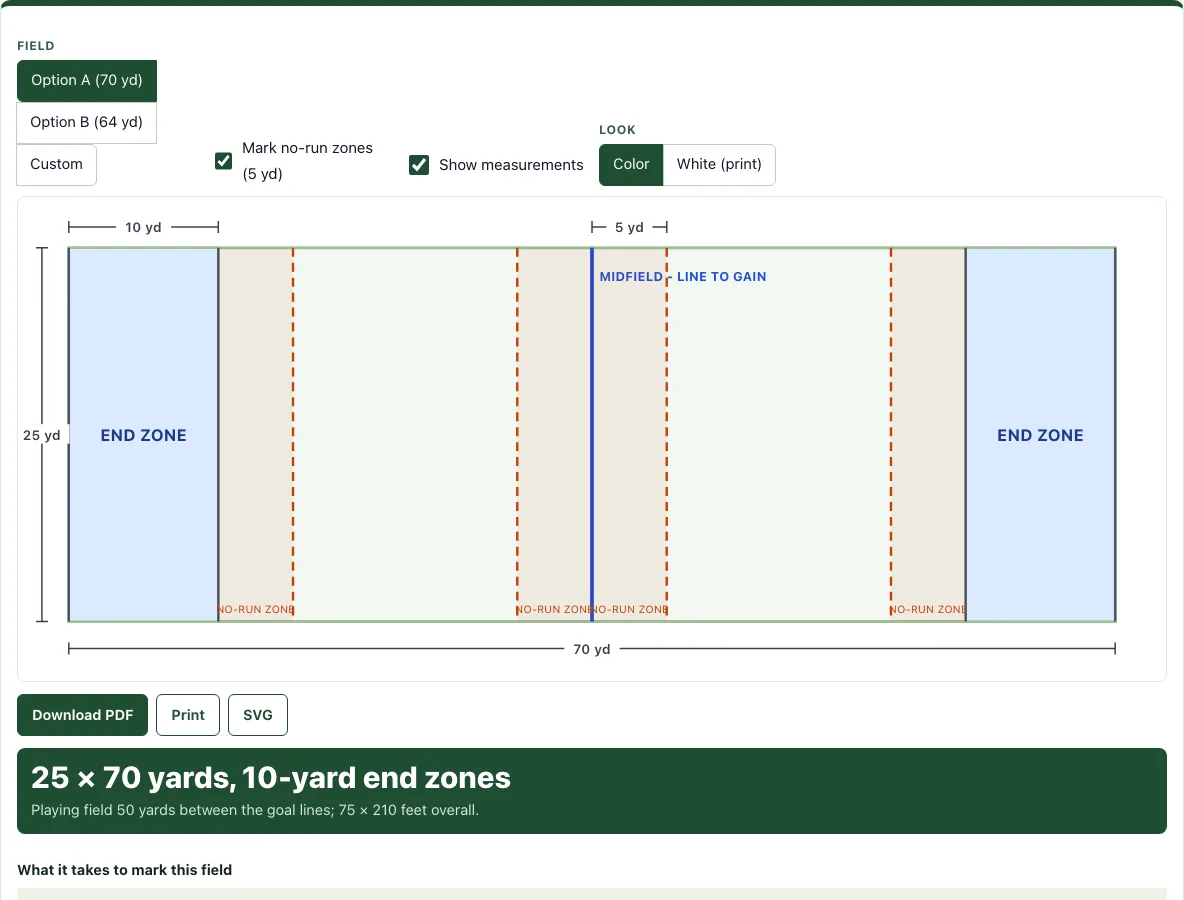
- Look at the field diagram. The line across the middle is the line to gain, and the shaded bands are the no-run zones.
- Pick Option A (25 x 70 yards) or Option B (25 x 64 yards) to match your field, or enter a custom size.
- Count your downs: four from your own 5-yard line to cross midfield, then three to score.
- Switch the labels and measurements on or off with the check boxes to get a cleaner picture.
- Press Print or PDF to get a copy for the sideline or a parent meeting.
Before the game, tell your players the two numbers: 4 and 3. A coach also has to say “punt” or “play” on 4th down, so decide what you will do on 4th down before the whistle. On a phone the tool fits one column. Printed or saved sheets keep their labels in black and white, so they photocopy cleanly for assistant coaches. What you type stays in this browser only; nothing is uploaded, and clearing the site data removes it. Check the values against your league sheet before you hand the printout to the other coaches, and save the PDF if you want a copy on your phone for game day.
How many downs do you get in flag football?
Under NFL FLAG rules, the offense starts at its own 5-yard line with four downs to cross midfield. After crossing midfield, it gets three downs to score. USA Football’s rules give four plays to reach midfield and four more to score, so the count depends on which rule set your league uses.
| Rule set | Downs to cross midfield | Downs to score after midfield |
|---|---|---|
| NFL FLAG | 4 | 3 |
| USA Football | 4 | 4 |
Before you play, check your league’s rulebook or ask the organizer which set applies. Mixing the two can cause confusion about when a drive is over.
What does 1st, 2nd, 3rd and 4th down mean in flag football?
Each down is one play. In NFL FLAG, the offense uses 1st through 4th down to move the ball across midfield. Once it crosses, it gets three downs to score. The ordinal tells you which play of the set you are on, so 2nd down means the second play since the last first down.
Penalties can change the count:
| Penalty | Who commits it | Result |
|---|---|---|
| Pass interference | Defense | Automatic first down |
| Flag guarding | Offense | 5 yards and a down |
Defensive pass interference gives the offense an automatic first down. An offensive penalty costs ground and uses up a down.
What happens on 4th down in flag football?
On 4th down in flag football, the offense chooses between punting and going for it. If it punts, the other team gets the ball at its own 5-yard line, and there is no kick. If it goes for it and does not cross midfield, the other team takes over where the 4th down play ended.
The offense’s head coach makes the call, and the timing matters:
- The referee asks the head coach to declare either “punt” or “play.”
- The coach must decide immediately. Waiting too long can lead to a delay of game penalty.
- If the team has declared “play,” it can use a timeout to change that call before the play clock expires.
As a coaching suggestion, not a rule: a punt is the safer choice deep in your own territory, and going for it makes more sense when the offense is close to midfield and needs only a short gain.
What happens at the end of a set of downs?
From NFL FLAG rule I.3:
| Situation | Result |
|---|---|
| Start of a possession | Offense starts at its own 5-yard line with four downs to cross midfield |
| Crosses midfield on any of the four downs | Three downs to score a touchdown from there |
| Fails to cross midfield and the coach says “punt” | Other team starts at its own 5-yard line |
| Fails to cross midfield after the coach says “play” | Other team starts where 4th down ended |
| Crosses midfield but fails to score on 3rd down | Other team starts at its own 5-yard line |
What happens after the offense crosses midfield?
After the offense crosses midfield, it has three downs to score a touchdown. If it fails to score on 3rd down, the ball changes possession, and the new offense starts at its own 5-yard line.
Two no-run zones on each drive affect how the offense can move the ball. One is the 5 yards before midfield, and the other is the 5 yards before the goal line. In either zone, every play must be a forward pass across the line of scrimmage, so the offense cannot hand off or run with the ball there. In 8U and younger regular-season games the no-run zones are removed (section XVIII).
How this tool works and where the numbers come from
Downs, possession and the line to gain come from rule I.3 and rule IV of the NFL FLAG playing rules; the field diagram uses the same field data as our field dimensions tool. USA Football’s different count is shown so you know to check your league.
Sources
- NFL FLAG, Official Playing Rules (revised 2025-03-24) · checked
- USA Football, Flag football rules (web page as read 2026-10-27) · checked
Frequently asked questions
How many first downs are there in flag football?
In NFL FLAG the line to gain is midfield, so a drive has one real first-down line. The offense has four downs to cross it and then three downs to score.
How many yards do you need for a first down in flag football?
No fixed number. In NFL FLAG the line to gain is midfield, so a team can need 20 yards or more, or just a few if it starts near midfield.
What is a turnover on downs in flag football?
It happens when the offense fails to reach the line to gain. The other team takes the ball at its own 5-yard line after a punt, or at the 4th-down spot if the offense chose to play.
Do all leagues use four downs and three downs?
No. USA Football describes four plays to cross midfield and four to score. Your league rule sheet decides.
Does it work on a phone or tablet?
Yes. The layout fits a phone, and you can print or save a PDF from the browser, then keep the sheet in your coaching bag.
Is it free and do I need an account?
Yes, it is free, needs no sign-up and runs in your browser.
Can I use what I make here commercially?
Yes. Diagrams and PDFs you make with this tool are yours to print, hand out, sell or put in your own products, with no credit needed. You may not copy the tool or the site itself; see the terms.
Related tools
- Flag Football Rules — The NFL FLAG 5v5 rules in plain words, with section numbers, a penalty table and a quiz
- Flag Football Field Dimensions — NFL FLAG field size, 25 x 70 or 25 x 64 yards, with a printable field diagram
- Football Field Diagram — A blank field layout for drawing plays or planning practice
- Flag Football Positions — Who plays where in 5v5 flag football and what each position does
- 5v5 Flag Football Plays — 14 plays for 5 on 5 flag football, checked against the NFL FLAG rules. Print them or edit any play
- How Long Is a Flag Football Game? — NFL FLAG regular season is two 24-minute halves on a continuous clock; tournaments use two 12-minute halves
- Can You Rush in Flag Football? — Yes, up to two defenders from 7 yards in NFL FLAG, except in younger divisions
- Flag Football Practice Plan — Build a timed practice plan by length, age group and focus