
How Many Players Are in Flag Football?
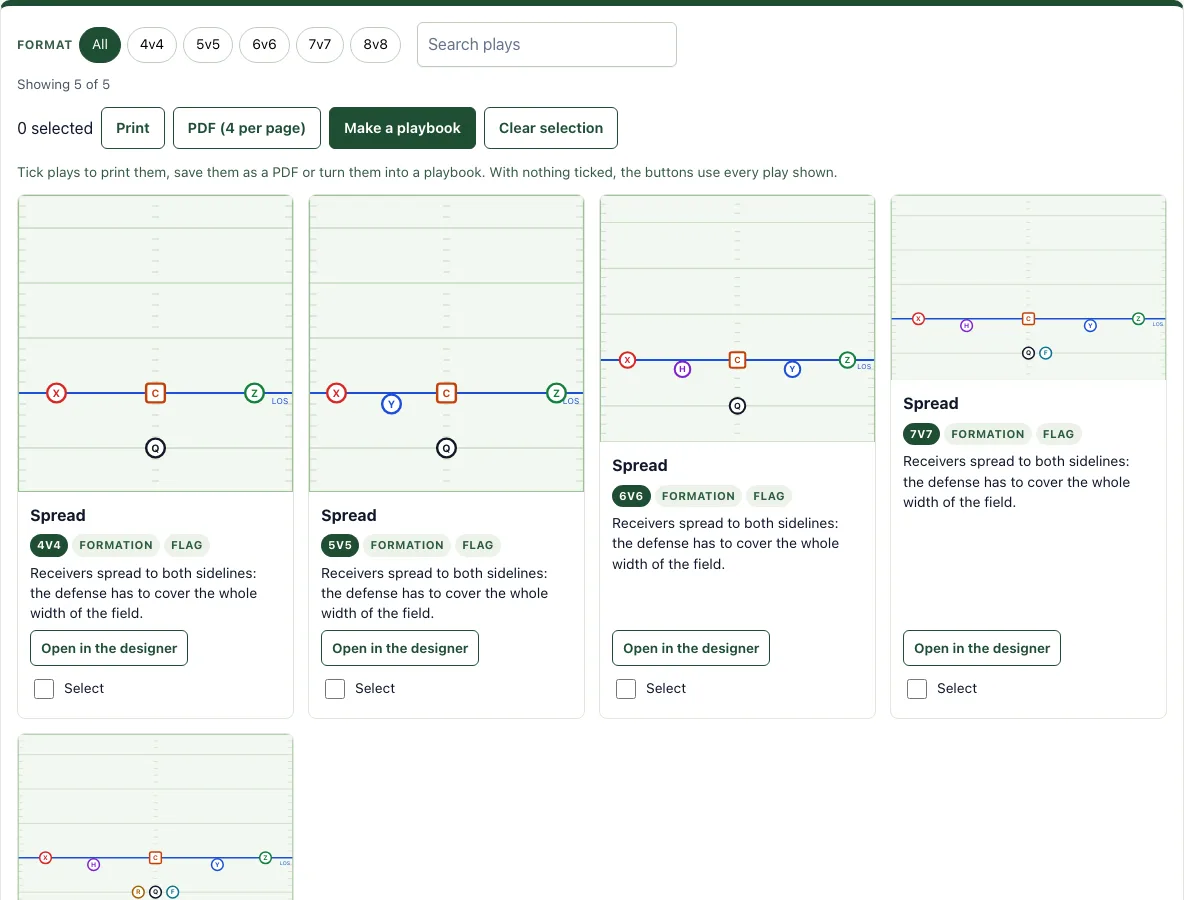
NFL FLAG plays 5 on 5, so five players per team are on the field at a time. Other leagues play 4v4, 6v6, 7v7 or 8v8, and each league sets its own roster size. The NFL FLAG rules do not give a roster number. The diagrams below show each team size from 4v4 to 8v8.
Spread
Receivers spread to both sidelines: the defense has to cover the whole width of the field.
Spread
Receivers spread to both sidelines: the defense has to cover the whole width of the field.
Spread
Receivers spread to both sidelines: the defense has to cover the whole width of the field.
Spread
Receivers spread to both sidelines: the defense has to cover the whole width of the field.
Spread
Receivers spread to both sidelines: the defense has to cover the whole width of the field.
Free · runs in your browser · nothing is uploaded
Recent
Your last 10 settings, saved only in this browser. Nothing is uploaded.
How to use the tool on this page
- Find your league’s format on the cards. Each card is labelled 4v4, 5v5, 6v6, 7v7 or 8v8.
- Use the format chips above the cards to show one team size at a time.
- Count the circles on a card. That is how many players each team has on the field in that format.
- Tick the Select box on the formats you want, then press Print or PDF. With nothing ticked, all five print.
- Press Open in the designer on a card to add routes for your team size and save or print your own plays.
Ask your league for its rule sheet before you plan plays. The format, the field width and the number of rushers can differ from league to league, and the cards on this page are our own diagram defaults for everything except 5v5. On a phone the cards stack in one column with the buttons under each card, and on a desktop they sit in a grid. Printed sheets keep their labels in black and white, so they photocopy cleanly for assistant coaches. Your ticked cards and edits stay in this browser only; nothing is uploaded, and clearing the site data removes them. Use the Select boxes before printing if you only want part of the set, and print one sheet per position group for a clean handout.
How many players are on the field in flag football?
Five players from each team are on the field at once in NFL FLAG flag football, on both offense and defense. That makes it a 5 on 5 game. Other flag football formats use more players per side, so check the rules of your league before you play.
Common formats listed on the NFL FLAG positions page:
| Format | Players on the field per team |
|---|---|
| 5 on 5 (NFL FLAG) | 5 |
| 6 on 6 | 6 |
| 7 on 7 | 7 |
| 8 on 8 | 8 |
| 9 on 9 | 9 |
The NFL FLAG rulebook points to the same count: rule IX.5 treats not returning five eligible players to the field after halftime as an unfair act.
How many players are on a flag football roster?
There is no single number. The NFL FLAG rules don’t set a roster size, so each league decides how many players a team can have. Check your league’s rules, or ask the organizer for two numbers:
- The minimum number of players needed to start a game.
- The maximum roster size for each team.
Once you know the roster limit, you can plan your lineup and rotation. Substitutions are allowed during any dead ball under NFL FLAG rule IX.4, so a team can bring players in and out between plays without waiting for a stoppage that’s specific to subbing. Your league may have its own substitution rules, so confirm those too.
What are the differences between 5v5 and 7v7 flag football?
5v5 and 7v7 differ mainly in field size and how many players are on the line. 5v5 is the NFL FLAG format, with a 25-yard-wide field and up to four players on the line. 7v7 has no single official rulebook, so each league sets its own field size and rules.
The main differences are below.
| Feature | 5v5 (NFL FLAG) | 7v7 (our diagrams) |
|---|---|---|
| Field width | 25 yards | 40 yards in our diagrams |
| Field length | 70 or 64 yards | Set by each league |
| Players on the line | Up to four | Up to six |
| Pass rush | Up to two defenders from 7 yards | Set by each league |
| Governing rules | NFL FLAG rulebook | Written by each league |
A 7v7 offense usually adds a back or tight end to the receiving group, and the defense can add linebackers. More players means more routes running at once and more width to cover, so check your league’s rules before you line up.
How do the flag football formats compare?
Only 5v5 is an NFL FLAG format. The other rows are the defaults of our diagrams (field width, players allowed on the line), not official rules.
| Format | Players per side | Diagram field width | Most players on the line |
|---|---|---|---|
| 4v4 | 4 | 25 yards | 3 |
| 5v5 (NFL FLAG) | 5 | 25 yards | 4 (rule XV.1) |
| 6v6 | 6 | 30 yards | 5 |
| 7v7 | 7 | 40 yards | 6 |
| 8v8 | 8 | 40 yards | 7 |
How do positions change with team size?
Team size changes positions by adding players, not by replacing the core roles. Each side in 5v5 has a quarterback, a center and three other players, with roles set by the play. In 7v7, the offense adds wide receivers, running backs and tight ends, and the defense can use linebackers.
| Format | Offense | Defense |
|---|---|---|
| 5v5 | Quarterback, center and three other players | Roles set by the play |
| 7v7 | Quarterback and center, plus wide receivers, running backs and tight ends | Linebackers can line up behind the rusher |
The labels change too. Our 5v5 Spread card names the players C, Q, X, Y and Z. Larger formats add H and F or a back, drawn from the same engine, so you can see which player fills each new slot.
How this tool works and where the numbers come from
Player counts for NFL FLAG come from the NFL FLAG positions page and rule IX.5 of the playing rules. The other formats are the defaults of our diagram engine, which we label as such because those formats have no single official rulebook.
Sources
- NFL FLAG, Official Playing Rules (revised 2025-03-24) · checked
- NFL FLAG, Flag football positions (web page as read 2026-10-27) · checked
Frequently asked questions
How many players are on a standard flag football team?
On the field, five for NFL FLAG, which plays 5 on 5. Other leagues use four to eight.
Are there different team sizes for various flag football leagues?
Yes. NFL FLAG plays 5 on 5, and leagues also run 4v4, 6v6, 7v7 and 8v8. Each league sets its own format, field size and roster.
How many players do you need to start a game?
The NFL FLAG rules we read give no minimum, so it is set by your league. Ask your league organizer for the number.
Does the number change for girls or high school flag football?
This page covers NFL FLAG and common league formats. High school and international programs follow their own governing bodies, so check their rule sheet.
Does it work on a phone or tablet?
Yes. The layout fits a phone, and you can print or save a PDF from the browser, then keep the sheet in your coaching bag.
Is it free and do I need an account?
Yes, it is free, needs no sign-up and runs in your browser.
Can I use what I make here commercially?
Yes. Sheets, cards, diagrams and PDFs you make with this tool are yours to print, hand out, sell or put in your own products, with no credit needed. You may not copy the tool or the site itself; see the terms.
Related tools
- Flag Football Positions — Who plays where in 5v5 flag football and what each position does
- Flag Football Rules — The NFL FLAG 5v5 rules in plain words, with section numbers, a penalty table and a quiz
- Flag Football Field Dimensions — NFL FLAG field size, 25 x 70 or 25 x 64 yards, with a printable field diagram
- 5v5 Flag Football Plays — 14 plays for 5 on 5 flag football, checked against the NFL FLAG rules. Print them or edit any play
- 7 on 7 Flag Football Plays (7v7) — 9 plays for 7 on 7 with diagrams and reads. Print them or open any play to edit
- Football Formations — 37 offensive and defensive formations for flag and 11-man football. Print them or edit any one
- 6v6 Flag Football Plays — 8 plays for 6 on 6 flag football with diagrams and reads. Print them or open any play to edit
- What Is the Best 5v5 Flag Football Formation? — Best 5v5 flag football formation: start with Spread, then add Trips, Bunch, Stack, a back in the shotgun or the I formation