
What Is a Motion Offense in Youth Basketball?
A youth basketball motion offense is a set of simple rules instead of set plays: pass, cut, fill the spot you left and screen for a teammate. Players read the defense and react. It teaches spacing and cutting to young players. Five basic actions are drawn on a half court below.
Pass and Cut
The base of motion offense: pass, cut through to the basket and out to the open spot while teammates fill behind you.
Pass and Screen Away
Pass to one side and screen for the player on the other side, who comes off the screen to the top.
Drive and Kick
The guard drives into the lane; when the help defender steps up, he kicks the ball out to the open shooter.
Give and Go
Pass to the wing, cut hard to the basket in front of your defender and get the ball back.
Backdoor Cut
When the wing is overplayed, he steps out, then cuts behind his defender to the basket; the high post hits him.
Free · runs in your browser · nothing is uploaded
Recent
Your last 10 settings, saved only in this browser. Nothing is uploaded.
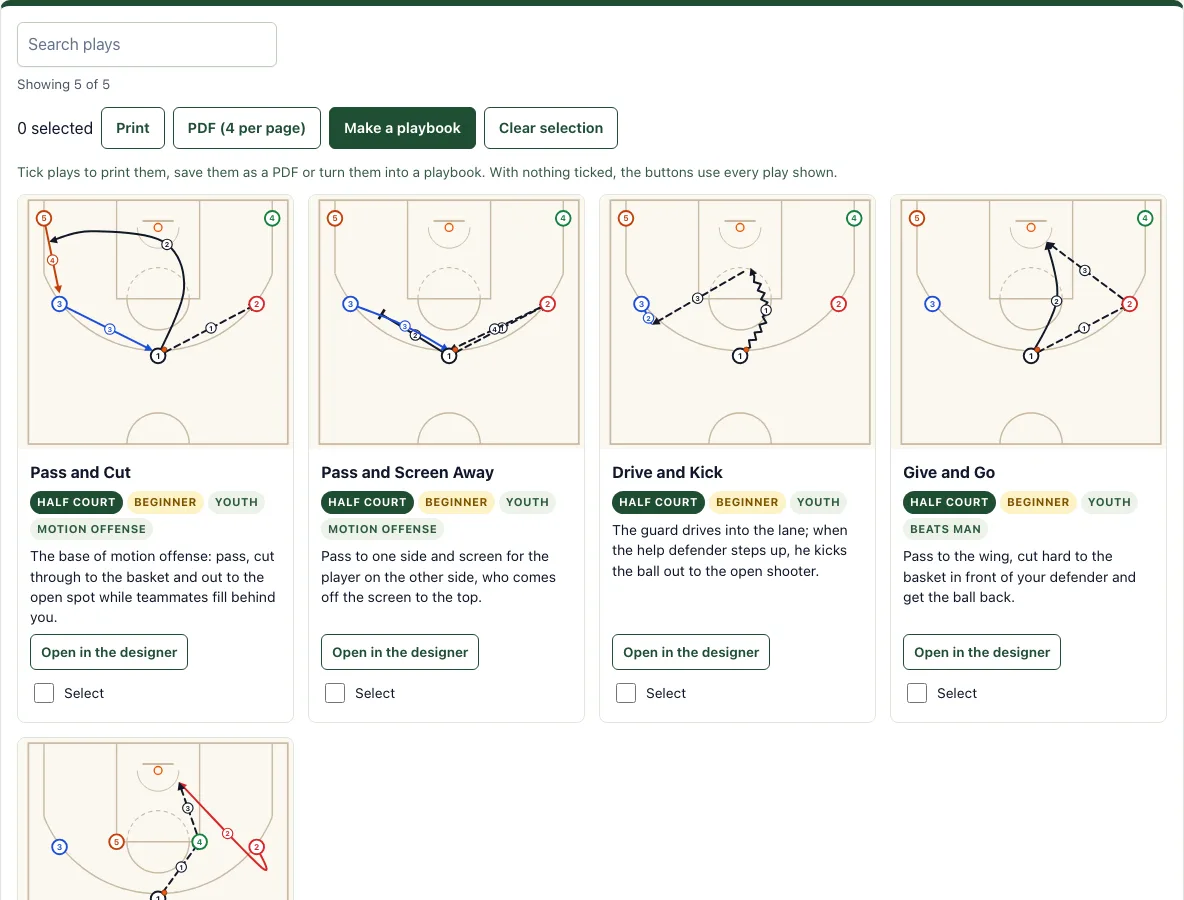
How to use the tool on this page
- Look at the five cards. Each shows one action on a half court, with the passes and cuts numbered in order.
- Teach Pass and Cut first. It is the base of the offense, and the other four are variations.
- Tick the Select box on the cards you want to keep.
- Press Print or PDF to put the ticked actions on a sheet. With nothing ticked, all five print.
- Press Open in the designer on a card to move a player or change a cut, then save or print your own version.
Run each action at walking pace first, five players on offense and no defense. Add a defender to each only when the cuts are automatic. Stop the drill after a few minutes and ask one player to explain what he did, so the idea is theirs and not just a diagram. On a phone the cards stack in one column with the buttons under each card, and on a desktop they sit in a grid. Printed sheets keep their labels in black and white, so they photocopy cleanly for assistant coaches. Your ticked cards and edits stay in this browser only; nothing is uploaded, and clearing the site data removes them. Use the Select boxes before printing if you only want part of the set, and print one sheet per position group for a clean handout.
What is a motion offense in basketball?
A motion offense is a style of basketball offense built on rules and reads instead of set plays. Players pass, cut and screen based on what the defense does, so the play changes as the defense changes.
The base action is pass and cut. You pass the ball, then cut through toward the basket and out to an open spot. Teammates move into the spaces you leave behind, and the next pass and cut keeps the ball and the players moving.
Motion works against man-to-man defense and can be adapted to zone. There is no single correct version. Coaches choose the rules and add their own actions, so two teams running motion can look quite different.
The diagrams on this page are drawn on an NBA-size half court. Youth courts are often smaller, so treat the spacing as a guide.
How do you teach a motion offense to youth players?
Teach it in stages. Begin with spacing: five players spread around the arc in a five-out set, with nobody in the lane. Introduce one rule at a time, then move from walking pace with no defense, to a passive defender, to live play.
Teach the rules in this order:
- Pass and cut. After you pass, cut toward the basket or to an open spot.
- Fill the empty spot. When a player cuts, a teammate moves in to fill the space.
- Screen for a teammate after a pass.
Once players understand these, teach the Pass and Screen Away action. The passer goes to one side and screens for the player on the other side. That player comes off the screen to the top of the key.
Keep sessions short. Stop while players still pay attention, and pick up the next rule the following practice.
What are the basic rules of a youth motion offense?
A youth motion offense is a set of simple movement rules that keep the five players spread out, moving, and passing, so the defense has to keep reacting. The main rules are to pass and cut, fill open spots, screen away, drive and kick, cut backdoor, and keep good spacing. Players don’t run set plays. They react to what the defender does.
- Pass and cut: After you pass, cut to the basket and move to an open spot.
- Fill: When a teammate cuts, take his spot so the court stays balanced.
- Screen away: After a pass, screen for a teammate who is on the other side.
- Drive and kick: When you drive and the help defender steps up, pass to the open shooter.
- Backdoor: When the defender overplays the pass, cut behind him to the basket.
- Spacing: Stay spread around the arc so one defender cannot guard two players.
Spacing matters most. If players bunch together, there is no room to cut or drive, and the motion breaks down.
Is a motion offense the easiest offense for kids?
A motion offense is often the easiest place to start with kids. They learn cutting and passing from a few simple rules instead of memorizing many plays, so they can start playing with confidence sooner. That makes it a practical choice for beginners.
Many coaches use motion as the base and add two or three set plays on top. Set plays help when your team needs a specific shot at the end of a game or a quick basket after a timeout.
Whether to run motion or set plays is a coaching choice, not a rule. Pick the approach your players can run without a coach shouting directions from the sideline.
How this tool works and where the numbers come from
The actions are drawn by our play engine on a half court with NBA dimensions. Motion offense is a teaching approach and has no official rulebook, so the rules listed are common coaching practice, not regulations.
Sources
- NBA Official Rules, Rule No. 1: Court Dimensions, Equipment (as read 2026-10-27) · checked
Frequently asked questions
What is the best offense for youth basketball?
There is no single best one. A motion offense is a common base because it teaches cutting, spacing and passing from a few rules. Many coaches add a couple of set plays.
What is the easiest offense scheme for kids?
Pass and cut. Players pass, cut to the basket and fill the open spot. The other actions on this page build on it.
Does motion offense work against zone defense?
Yes, with changes: players cut into gaps instead of toward their defender, and the ball moves quickly from side to side. See the 2-3 zone page for plays that attack that zone.
How many players run a motion offense?
Five players, usually in a five-out or four-out set on a half court.
Does it work on a phone or tablet?
Yes. The layout fits a phone, and you can print or save a PDF from the browser, then keep the sheet in your coaching bag.
Is it free and do I need an account?
Yes, it is free, needs no sign-up and runs in your browser.
Can I use what I make here commercially?
Yes. Sheets, cards, diagrams and PDFs you make with this tool are yours to print, hand out, sell or put in your own products, with no credit needed. You may not copy the tool or the site itself; see the terms.
Related tools
- Basketball Plays For Youth — Simple half-court plays for youth teams, drawn and numbered in order
- Basketball Plays — Basketball plays and set actions drawn on a half court. Print or edit them
- Basketball Playbook — Collect basketball plays into a team playbook and print it
- Basketball Play Designer — Draw passes, cuts and screens on a half or full court
- 2-3 Zone Defense — Where the five defenders stand in a 2-3 zone and the plays that attack it
- Basketball Whiteboard — A free basketball whiteboard for sketching plays and drills
- Basketball Court Diagram — NBA and FIBA court lines with measurements, printable
- Basketball Inbound Plays — Baseline and sideline out-of-bounds plays drawn on a half court